
- How are soccer goals constructed?
- What are the differences between goals with and without depth?
- How do I know which size soccer goal is right for my age and skill level?
- Should I get a portable or permanent soccer goal?
- How do I install a soccer goal?
- Which training goal is right for me or my team?
- Are pop-up soccer goals a good option for me?
- How do I know which soccer net is right for my goal?
How are soccer goals constructed?
Soccer Goals come in a huge variety of sizes, shapes, and options, designed for everyone from the littlest athlete, practicing in his backyard with dad, to the most precise, professional World Cup team on the planet. Generally though, soccer goals are made of two materials, either plastic or metal (usually aluminum), which determine the goal's price, purpose, and performance.
- Plastic Soccer Goals
- Afforable
- Lightweight
- Portable
- Easily installed onto field or grass with anchors
- Can be adjustable, foldable, collapsible, and storable
- Designed for youth players, training, and recreational play
- Less durability and weight than metal, makes them best suited for low-impact, low-use play
- Metal Soccer Goals
- High-grade design for serious play
- More expersive than plastic
- High performance and durability
- Designed for permanent or semi-permanent installation
- Great for high impact play
- Ideal for soccer clubs, leagues, schools, tournaments,etc.
- Available in a range of sizes and styles
What are the differences between goals with and without depth?
Soccer goals are designed differently, for different ages, players, and leagues. Some goals are simple, while others are more complexly designed. It's important to understand the different styles of soccer goals, to know which one is right for your player, your league, and your budget.
- Goals Without Depth
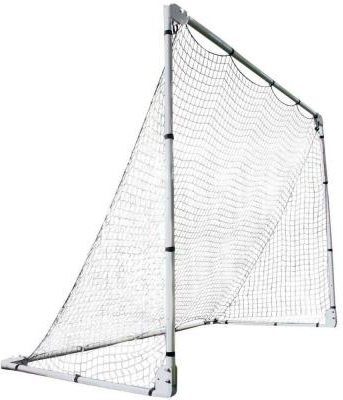
- Simply designed soccer goals with a single top cross bar
- Net hangs down and connects to the side and back bars, creating a 45 degree angle to the ground
- Typically lighter and more portable
- Provides no room for the goalie to defend inside the goal itself
- Limits room inside the goal
- Goals With Depth
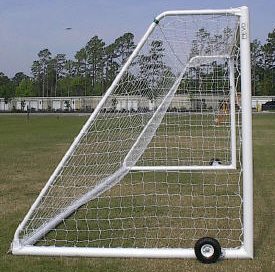
- More complex designs with a single top bar and two bars at a 90 degree angle to the front bars, that extend back a few feet into the net
- Bars and net drop at a 45 degree angle to the back of the net
- Creates more room inside the net to prevent player tangling and improve goalie performance
- Manufactured with a heavier and higher-quality metal or plastic
- Can be permanent or portable
- Found in youth or middle school competitions
- Box Goals
- Large rectangular shaped soccer goals designed with a box-frame of all 90 degree angles
- Net is looped over the frame allowing for the most possible space inside the goal
- Typically used for professional or high-level soccer clubs
- Generally heavy metal goals, available in permanent or portable options
How do I know which size soccer goal is right for my age and skill level?
Anyone can play soccer with any sized goal, on any size field. But if you're going to play in a sanctioned league, or want to practice with a goal sized just for you, there are specific size soccer goals that are appropriate for different age players. Leagues across the country, and the world, adhere to these player age / goal size rules, so it's important to know them when looking for a new soccer goal for your player, your club, or your league.
| Recommended Goal and Field Sizes | ||||
| Age | Goal Size | Field Size | 6 - 7 | 4' H x 6' W | 15 yards W x 20 yards L | 8 | 6.5' H x 12' W | 30 yards W x 50 yards L | 9 | 6.5' H x 18.5' W | 35 yards W x 50 yards L | 10 - 13 | 6.5' H x 18' W, 7'H x 21' W | Range from 45 x 55 to 70 x 80 | 13 - Adult | 8' H x 24' W | Range from 50 x 100 to 80 x 120 |
Should I get a portable or permanent soccer goal?
This depends entirely on what type of goal you need, your budget, and your playing space. Portable Soccer Goals are lighter weight, may be folded, and are fairly easily moved for storage. They are great for practice, training, and even games on public fields, where permanent goals cannot be installed. Portable goals are temporarily installed with simple anchors, which can be removed when the game is over. They come in all sizes, designs, and prices, from affordable and basic training rebounders for youth players, to more expensive, full size 8' x 24' tournament-style goals. Typically, portable goals are less expensive than their permanent-installation counterparts, due mostly to their lower weight.
Permanent, semi-permanent, or in-ground soccer goals?are among the heavier, and more expensive soccer goals on the market. They are also the most durable, dependable, stable, safe, and high-performing goals out there. That's because, with rugged aluminum frames, and in-ground anchors and footings, these goals hold up to plenty of use, and remain stable even during the most intense game play. Because of their expense, and the space required, permanent or in-ground installation soccer goals are great for soccer clubs, schools, professional teams, stadiums, and year-round soccer fields, with plenty of room and a dedicated or year-round soccer league or team.
How do I install a soccer goal?
Soccer goal installation is typically pretty simple and easy, even in the case of permanent, or semi-permanent soccer goals. Sometimes, as in the case of portable or wheeled soccer goals, installation is as simple as carrying or pushing the goal onto the field! But for all goals, you're going to need to either anchor, install, or weigh down the goal, to keep it stable and upright during the game. The installation needs to be done right, or your goal may fall over after a hard shot, and may run the risk of injuring players or bystanders. (Please Note: the following are general installation suggestions. Always follow installation instructions found on every soccer goal)
- Portable Soccer Goals
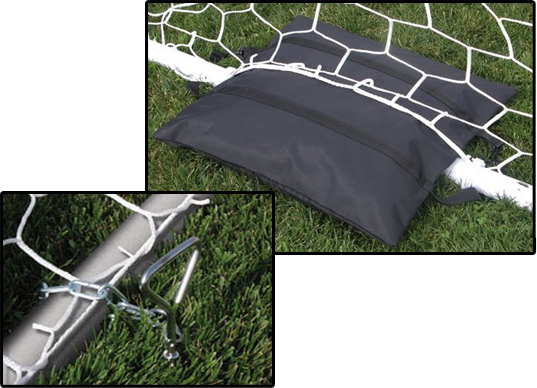
- Anchor the goal to the grass or turf using plastic or metal in-ground anchors, through the net or attached to the frame
- If anchors are NOT provided, or goals are used on hard concrete or gym surfaces, secure goal frame to the ground using weights or sandbags
- Place weights over the back bar and side bar frames if necessary
- Permanent or Semi-Permanent Soccer Goals
- Install ground stems into the grass or turf (ground sleeves should be included with your purchase) where the goal frames will be installed
- Semi-permanent soccer goals - install ground sleeves 10" into the ground
- Permanent soccer goals - install ground sleeves 36" into the ground
- Place soccer goal frames into the ground sleeves to secure placement
Which training goal is right for me or my team?
Once you've got all your Soccer Gear, you'll want to get better. To sharpen your game and develop soccer skills, it's important to get out and practice! That's why we stock some of the most versatile and diverse soccer training goals, rebounders, and targets in the game today. These training goals can be used at home in the backyard, or on the field with your team. It's all about finding the one that works for you, your skill level, your space, and your budget.
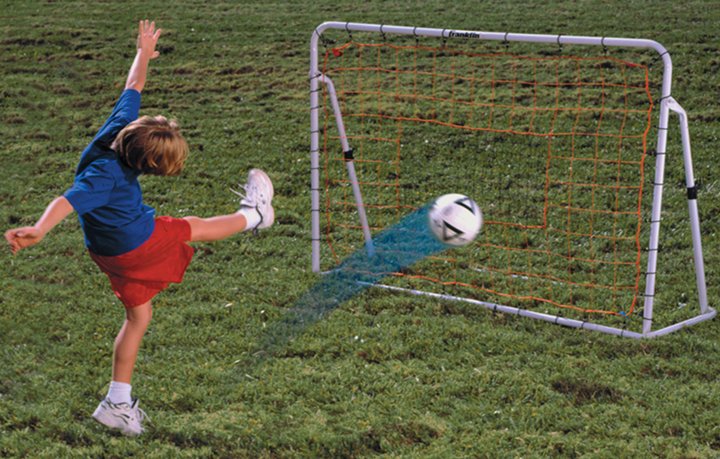 Soccer Rebounders:With the frame of a traditional soccer goal, but with a taught net designed to send the soccer ball back to you, soccer rebounders let players practice their shooting power, accuracy, placement, and speed. Soccer rebounders come in all shapes and sizes, and are affordable enough for for personal use or team practice. Great for players of all ages and skill levels!
Training Goals:Extremely lightweight and portable, training goals are quick to set up and can get just about anywhere. They let you practice your shots and skills in the park, the backyard, or even on the sidelines during a game! Incredibly versatile, and also affordable, training goals are?great for every player on the field.
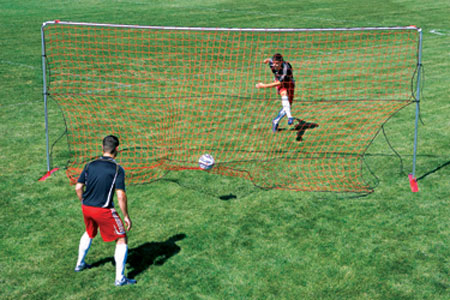 Coerver Coaching Goals: A double sided soccer goal, with a single frame and net design, Coerver goals let coaches run multiple drills and train the entire team all at once! It also lets two goalies train at the same time. Designed for more advanced players and teams, Coerver goals are great for soccer clubs, schools, and advanced league training.
Are pop-up soccer goals a good option for me?
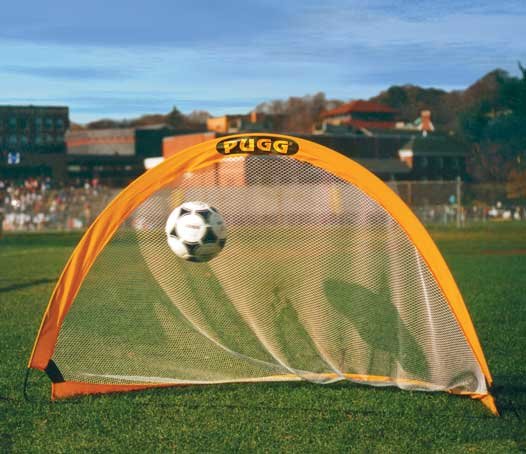
Pop Up Soccer Goals are some of the coolest, most versatile soccer goals on the market! Made of a lightweight, bendable, yet sturdy frame, with a nylon cover, they collapse down to a flat circle for easy storage and transportation, and when you're ready to play, they simply pop back into shape! Complete with a fine mesh net and anchor pegs for instant secure play, pop-up goals are easy to set up in the park or the backyard.
- Because of their size, versatility, and affordability, pop-up soccer goals are perfect for:
- Recreational, pick-up, or backyard soccer games
- Personal practice at home or on the sideline
- Youth and developing players
How do I know which soccer net is right for my goal?
If your soccer net is old, torn, damaged, tangled, or out-dated, it's definitely time to replace it with a brand new soccer net! But which one do you go with, and how do you know it's the right one for your goal? After all, soccer nets all look the same! This can definitely make your decision a little tough, but when you know what to look for, you'll see how different soccer nets really are, and you'll find that getting the right one for you is fairly simple.
- Net Size - Nets, like goal, come in standard sizes, to fit standard goal frames. If you have a youth 4' x 6' soccer net, you're going to look for a 4'x 6' soccer net.
- Net Depth - Some advanced soccer goals have depth to them, allowing for more room inside the goal. Replacement soccer nets need to have depth as well, to fit these frames. Look for soccer nets with three or more dimensions (i.e., 8' x 24' x 6' x 6'). The first two refer to the net's length and width. The second two dimensions refer to the net's top depth and bottom base depth.
- Rope Size - The durability, performance, and price of a net has a lot to do with its rope thickness. Economical soccer nets usually feature a 2mm thick rope, while more advanced, pro-level and expensive nets use a 3 or 3.5mm rope.
- Mesh Width - The tightness of the net mesh affects the net's performance and durability. Most soccer net mesh is 120mm wide, while other soccer nets feature tighter knits, at 3.5" (88.9mm) or ever a 5.5" (139.7mm) hex mesh.
- Net Attachments - Modern goals come with secure net fastener systems, like clips and bars, which secure the net to the frame. It's important to either buy a goal with these features, or add them to existing goals with separately purchased and installed clips. Velcro strips are also great for temporarily securing nets to frame poles.
Once you've got the right goal for your needs, you may want to gear up those who will be protecting it. Sports Unlimited carries everything you need to keep a clean sheet. From Goalie Gloves to Keeper Apparel. Not sure what gloves you need? Check out our Goalie Gloves Buyers Guide.