
Common Injuries for Football and How Players Can Help Reduce Risk
Posted by Lou Rusnock on Dec 5th 2025
Table of Contents
- Why Football Injuries Happen
- Most Common Football Injuries
- Injury Prevention Strategies
- Protective Gear from Sports Unlimited
At a Glance: Football is a contact sport with fast movement, collisions, and repetitive stress. This is why football injuries are common, especially in the legs, shoulders, and head. Preparation, strength training, proper warm-ups, good technique, and protective gear can help reduce risk. Understanding these injuries supports safer performance.
Football demands strength, speed, coordination, and awareness. A football player accelerates, cuts, blocks, and tackles throughout practice and competition. These movements place stress on joints, ligaments, and muscles. Football-related injuries can occur at youth, high school, and older levels because the game involves contact and fast directional changes.
Learning about the most common injury patterns can help players, parents, and coaches make supportive decisions about training and recovery. Awareness encourages players to take note of soreness, rest when needed, and practice safer mechanics. Preparation, conditioning, and properly fitted protective gear can help athletes perform with more confidence on the field.
Why Football Injuries Happen
Football is a contact sport that includes forceful collisions and rapid movement. This puts stress on both the upper and lower body.
Common contributing factors include:
- Direct blow during tackling or blocking
- Sudden change of direction while sprinting or reacting
- Fatigue reduces balance and muscle control
- Overuse injury patterns from repeated practice and play
- Protective gear that does not fit correctly or has worn down
Knowing these common causes improves training awareness and encourages players to build habits that support safer movement on the field.
Most Common Football Injuries
Concussion (Traumatic Brain Injury)
A concussion may occur when the head or body absorbs force that causes the brain to shift inside the skull. This can affect how a player thinks, feels, or reacts. Symptoms may appear quickly or develop over time. Players should not return to play on the same day as a suspected concussion and should follow a supervised return-to-play progression.
Common signs may include:
- Headache or pressure in the head
- Dizziness or balance trouble
- Sensitivity to sound or light
- Feeling slowed or unfocused
Players should report symptoms clearly. Rest and gradual return under supervision supports recovery. Tackling with the head up can help reduce the chance of head contact.

ACL Tear (Anterior Cruciate Ligament)
An ACL tear is a common knee injury involving the anterior cruciate ligament in the knee joint. It can occur when a player plants the foot and rotates or changes direction rapidly. Swelling and instability may appear soon after injury. Most football players with a complete ACL tear require surgical reconstruction to safely return to pivoting and contact play.
Situations where ACL injury is more likely include:
- Quick directional cuts
- Landing awkwardly after jumping
- Collision that affects knee position
Recovery often involves physical therapy to restore strength and movement control.
MCL Injury and Meniscus Tear
The medial collateral ligament supports the inner knee, while the meniscus cushions the knee joint. Both can be affected when the knee bends inward or rotates under pressure.
Common causes include:
- Block or hit to the side of the knee
- Twisting the knee while foot remains planted
- Tackles involving lower body entanglement
An orthopedic surgeon may evaluate treatment options depending on severity. Some cases improve with rest. Others may need a more structured recovery plan.
PCL Injury (Posterior Cruciate Ligament)
The posterior cruciate ligament supports knee stability. A posterior cruciate ligament injury may occur when the shinbone is pushed backward while the knee is bent. PCL injuries are less common than ACL injuries, and many can be managed with rehabilitation rather than surgery, depending on severity.
Situations that may lead to PCL injury include:
- Falling directly on a bent knee
- Contact during pile-ups in close play
- Landing off balance during pursuit
Rehabilitation focuses on restoring strength and movement control.

Ankle and Foot Injuries
The ankle and foot carry load during sprinting, cutting, and push-off. These structures experience high strain.
Common injuries include:
- Rolling or twisting the ankle
- Landing on another player's foot
- Sudden cut while changing direction
- Sprain of the big toe joint
- Often occurs on artificial turf during push-off
- Can make sprinting and sharp acceleration difficult
Balance work and ankle control training may support recovery and decrease the chance of recurring issues.
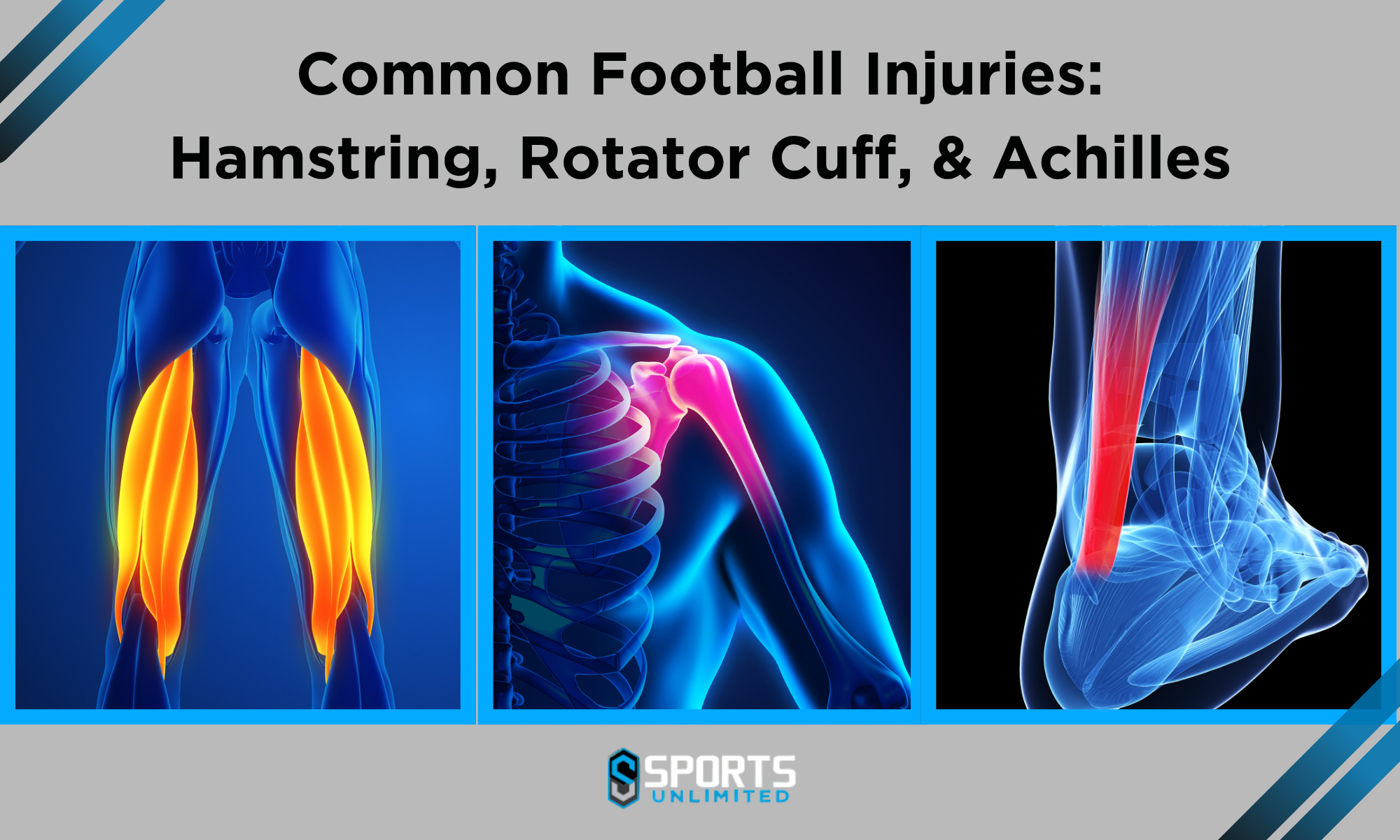
Hamstring Strain
The hamstring muscles along the back of the thigh support sprinting and acceleration. A hamstring strain may occur when the muscle lengthens under tension.
Contributors may include:
- Sprinting without fully warming up
- Muscle fatigue at the end of practice
- Shortened stride from tight muscles
Gradual strengthening and flexibility work may reduce recurrence and help control muscle strain patterns.
Shoulder Injury (Rotator Cuff and AC Joint)
The shoulder joint supports blocking, tackling, and reaching movements. Shoulder injury may occur during impact or when the arm is extended. Rotator cuff injuries may limit arm motion and strength.
Common causes include:
- Tackling with an arm outstretched
- Landing directly on the shoulder
- Repeated contact during blocking
Strength training that supports the shoulder joint can help improve stability over time.
Achilles Tendonitis
The Achilles tendon connects the calf muscles to the heel. It may become irritated during repeated sprinting or strong push-off movements.
Common signs include:
- Tightness in the back of the lower leg
- Stiffness during running
- Discomfort during acceleration
Gradual strengthening and controlled progression of running intensity may be part of recovery.
Shin Splints
Shin splints involve discomfort along the lower leg due to repeated running stress. If ignored, stress fracture concerns may increase. If pain becomes sharp or localized to one spot, medical evaluation is recommended to rule out a stress fracture.
Contributing factors include:
- Repetitive running impact
- Rapid increase in practice volume
- Footwear that does not match the running style
Reviewing training surfaces and footwear selection may support improved comfort.
Finger, Hand, and Wrist Injuries
Players use their hands constantly for blocking, catching, and ball control. This can lead to sprains or jammed fingers.
Typical situations include:
- Fingers caught during blocking
- Ball contact during a catch
- Hands absorbing force during a fall
Gloves and taping may provide support, depending on position. This is especially common for a defensive lineman working in contact-heavy play.
Injury Prevention Strategies
Reducing the chance of severe injury involves practice habits and supportive routines.
Helpful approaches include:
- Strength training for hips, legs, and core stability
- Dynamic warm-ups before activity
- Practicing safe movement technique
- Adequate recovery time between sessions
- Early attention to discomfort or soft tissue irritation
These habits support consistent performance and safer participation.
Protective Gear from Sports Unlimited
Football equipment supports the body during contact, impact, and movement. Choosing protective gear that fits well can help players move confidently while managing the stress placed on joints and ligaments. Sports Unlimited offers a full range of football gear, including helmets, mouthguards, shoulder pads, padded girdles, and padded pants, all designed to support protection and mobility on the field.
Shopping for gear that fits well supports comfort and movement control on the field. Shop Sports Unlimited to find protective football gear that fits well and supports confident play, from youth leagues through high school and beyond.