
What Is OPS in Baseball? A Complete Guide to On-Base Plus Slugging
Posted by Doug Ervin on Mar 12th 2026
- What OPS Means in Baseball
- The Two Parts of OPS: OBP and SLG
- How to Calculate OPS
- What's a Good OPS?
- How to Use OPS When Comparing Hitters
- The Limits of OPS
- OPS+: OPS With Context
- All-Time OPS Leaders
- Sports Unlimited: Your Source for Baseball Gear
Short Answer: OPS stands for On-Base Plus Slugging. You calculate it by adding a player's on-base percentage (OBP) to their slugging percentage (SLG). The stat gives you a quick snapshot of a hitter's overall offensive value, not just how often they get hits.
What OPS Means in Baseball
OPS combines two major offensive skills into one number. As analysts started looking for a cleaner way to summarize run creation, they settled on OPS because it's built from two already-meaningful pieces: on-base percentage, which tracks how often a hitter avoids making outs, and slugging percentage, which captures extra-base power. Add OBP and SLG together, and you get a single number that quickly reflects a player's overall offensive impact.
How OPS Improves on Batting Average
The formula is simple:
OPS = OBP + SLG
That single number tells you more about a hitter than batting average ever could. A bloop single and a home run carry equal weight in the BA column, and walks don't count at all. The stat accounts for everything.
That's why the stat caught on across Major League Baseball. It lines up closely with run production, which is what offense is really about. You'll find it on Baseball Reference, on baseball cards, and in nearly every broadcast graphic.
Why OPS Is So Popular
It's easy to understand and easy to compare across players. One number covers both getting on base and hitting for extra bases. As an offensive statistic, it gives a more complete picture than traditional statistics on their own.
It also bridges the gap between old-school stats and the advanced stat movement that reshaped baseball analytics. The stat was one of the first numbers to push player evaluation beyond just hits and home runs.
The Two Parts of OPS: OBP and SLG
Understanding each part helps you see what the number is actually telling you about a hitter.
On-Base Percentage (OBP): How Often a Player Reaches Base
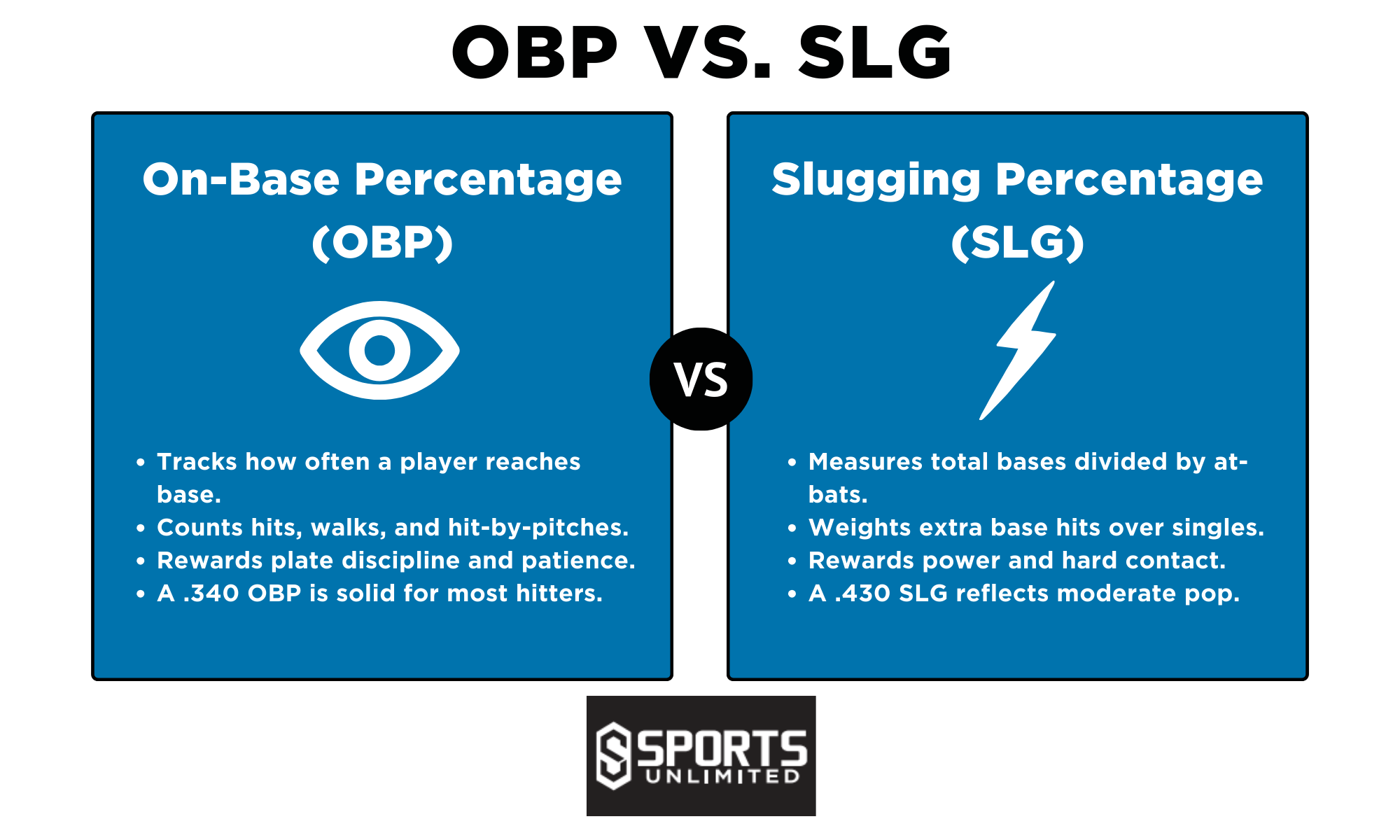
OBP tracks how frequently a player reaches base per plate appearance. It counts hits, walks, and hit-by-pitches. Sacrifice flies count against the hitter in the denominator, but sacrifice bunts do not. You can find the full formula on Baseball Reference.
The stat rewards plate discipline. A hitter who draws walks keeps innings alive, even when their swing is off. Over enough plate appearances, OBP shows which hitters create the most opportunities for their team.
Slugging Percentage (SLG): How Much Power a Player Produces
Slugging percentage equals total bases divided by at-bats. A single counts as one base, a double as two, a triple as three, and a home run as four. SLG rewards extra base hits more heavily than singles.
Power changes games fast. One home run can score multiple runners and flip a scoreboard. SLG captures that offensive contribution directly.
How to Calculate OPS
Find the player's OBP, find their SLG, and add them together. The result usually falls between .600 and 1.100 for Major League Baseball hitters.
A Simple OPS Example
Say a hitter has a .340 OBP and a .430 slugging average. Add them: .340 + .430 = .770 OPS. That tells you the hitter gets on base at a solid rate and has moderate extra base power. A .770 places them right around average for the league.
OBP reflects getting on base. SLG reflects damage on contact. Together, they blend into one number that gives you a fast read on overall offensive production.
What's a Good OPS?
League average OPS typically sits between .730 and .760, depending on the season. Run environments shift year to year based on pitching trends and rule changes. Compare the number to what the average was for that year. Check sites like FanGraphs for seasonal averages.
Common OPS Benchmarks
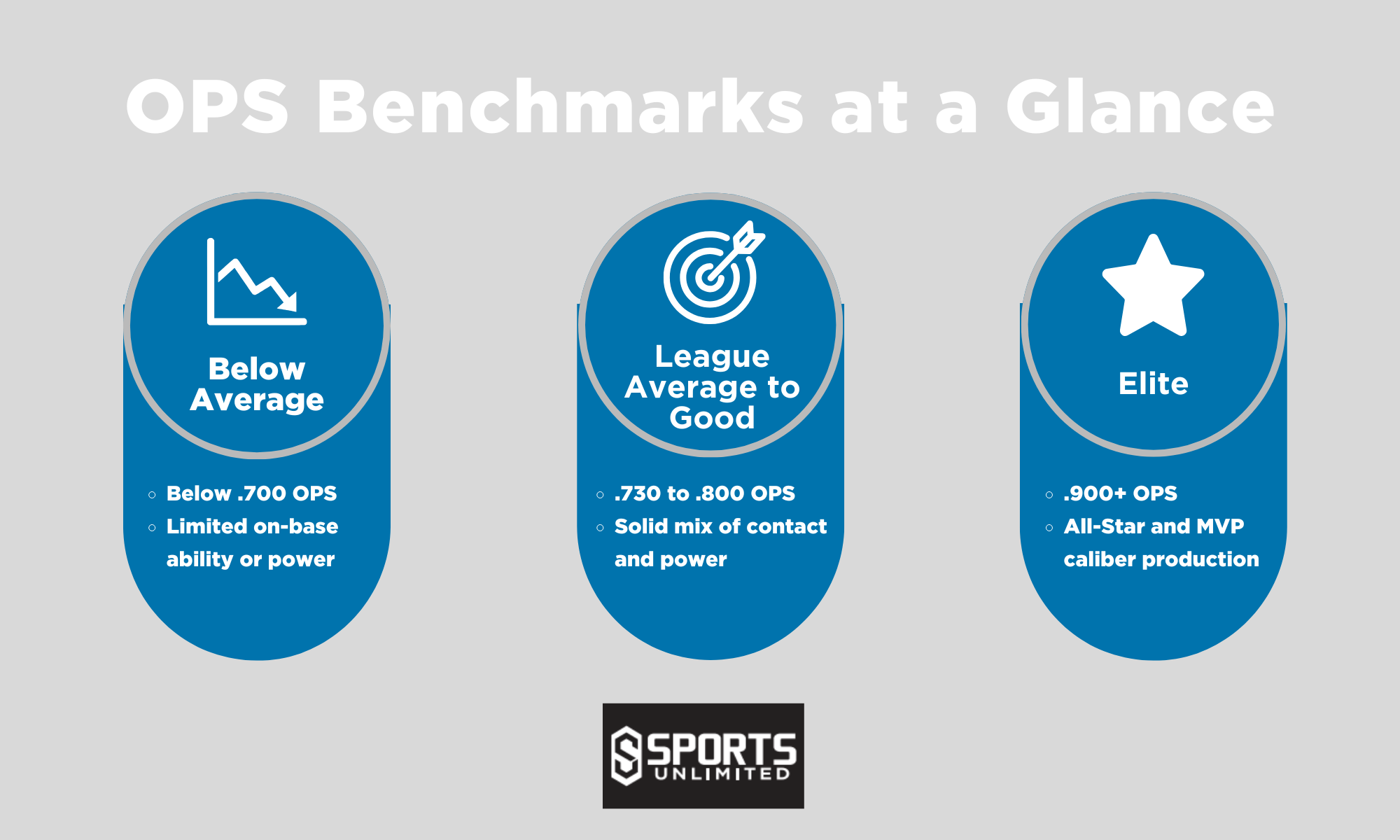
- Below .700: Below average hitter
- Around .750: League average
- .800 and above: Above average, good hitter
- .900 and above: Excellent hitter, All-Star caliber
- 1.000 and above: Elite, superstar level
These are rough guides. A player's number can shift based on standard deviation within a season, ballpark, and the overall averages that year.
How to Use OPS When Comparing Hitters
The stat works well as a quick comparison tool. It gives you one number that covers both on-base ability and power. When evaluating a player's offensive capabilities, it makes it more useful than a single traditional stat.
OPS vs. Batting Average
Batting average doesn't count walks. It also treats every hit the same. A bloop single and a home run carry equal weight. The stat fixes both problems. It rewards hitters who draw walks and drive the ball for extra bases. That's why it replaced batting average as the preferred offensive statistic in modern player evaluation.
What a High OPS Hitter Looks Like
A hitter with a high OPS typically gets on base often, hits for extra base power, or both. A higher number generally means the player reaches base consistently and drives the ball. These are middle-of-the-order hitters who produce runs.
The Limits of OPS
The stat is a useful starting point, but it has blind spots. It does not account for ballpark effects, era, or league context. A .900 OPS in a hitter-friendly ballpark means something different than that same number in a pitcher's park.
What OPS Leaves Out
Park factors play a real role. Some ballparks inflate offensive numbers while others suppress them. A player's performance should be measured against the standard deviation and averages of their specific context. Small sample sizes can swing the number quickly, too.
Even with those gaps, the stat remains a valuable tool. It's simple, available on Baseball Reference, and tells you more than traditional statistics. Think of it as your starting point before digging into advanced metrics. It works best alongside other numbers, not as a complete evaluation on its own.
OPS+: OPS With Context
Because raw OPS lacks context, analysts often pair it with OPS+. This sabermetric baseball statistic normalizes the number relative to the league average and home ballpark. A 100 OPS+ means exactly average. Anything above 100 is better.
OPS+ adjusts for league average OPS and park effects. That makes it cleaner for comparing players across teams and ballparks, especially when looking at statistical data from different offensive environments.
When to Use It
Use OPS+ when comparing hitters from different teams, parks, or eras. If you want to know whether a player's offensive performance was truly elite in context, OPS+ gives a better answer. Find it on Baseball Reference next to standard batting stats.
All-Time OPS Leaders
Many of the greatest hitters in baseball history posted the highest OPS numbers ever recorded. Babe Ruth holds the highest OPS in baseball history at 1.164. Ted Williams is right behind him. Barry Bonds, Mark McGwire, and Mickey Mantle also rank among the all-time leaders.
How the Stat Shaped Modern Baseball
Pete Palmer and John Thorn, early advocates of sabermetric statistical analysis, helped popularize the stat as a way to measure a player's ability. The Oakland Athletics leaned on it and on-base average during their Moneyball era, using linear weights and advanced stat analysis to compete with bigger-budget teams in baseball operations. That approach reshaped how the sport values a player's offensive prowess and shaped modern baseball analytics.
All-time leaders show what elite production looks like. But always compare players to their league and season. A single-season OPS of .950 might be historically great in one era and merely excellent in another. Standard deviation data on Baseball Reference gives you a fuller view of a player's offensive performance across eras.
Sports Unlimited: Your Source for Baseball Gear
Gear That Supports Better At-Bats
Gear alone won't raise your OPS. But the right equipment helps you put in quality reps. Good batting gloves give you a reliable grip, reduce sting on mishits, and let you focus on your swing. The right bat matters too, so match it to your league rules and swing style. Training aids like batting tees, practice nets, and weighted balls help you build the consistent contact and extra base power that show up in your numbers over time.
Sports Unlimited provides baseball players with access to top-tier gear across batting gloves, bats, training aids, and more. Same-day shipping on orders placed before 3 PM and free shipping on most orders over $49 mean athletes get equipment without delay. The selection covers every position and budget, so you can find the right fit for your game.
Shop Sports Unlimited's full baseball collection today to find the gear that keeps you performing through every at-bat.