
Football Conditioning Drills for Preseason: Build Speed, Agility, and Endurance
Posted by Lou Rusnock on Jun 4th 2026
- What Good Preseason Conditioning Covers
- Warm-Up Drills to Start Every Practice
- Sprint-Based Conditioning Drills
- Agility and Footwork Drills
- Position-Specific Conditioning
- Building a Safe and Effective Preseason Program
- Sports Unlimited: Gear Up for Preseason
- Frequently Asked Questions
At a Glance: The best football conditioning drills train short bursts of speed, quick direction changes, and repeated high-intensity effort. Sprint ladders, agility ladder drills, tempo runs, and position-specific exercises are among the most effective for preseason preparation.
According to USA Football's National Practice Guidelines, the average play in football lasts about five seconds with 25 to 30 seconds between plays. That means preseason conditioning should prioritize short bursts, recovery, and repeated high-intensity effort over long distance running.
What Good Preseason Conditioning Covers
A strong preseason program trains four areas together: strength for power and injury protection, stamina for sustained performance, agility for quick direction changes, and speed for short-distance explosiveness. This guide covers the most effective football conditioning drills for the preseason, organized by category.
Warm-Up Drills to Start Every Practice
Before any high-intensity conditioning begins, players should warm up properly. Skipping this step leaves muscles cold and unprepared, which can increase the risk of injury early in practice. The CDC's guidance for athletes training in heat also recommends starting activities slowly and picking up the pace gradually, which applies directly to the preseason warm-up structure.
High Knees
Players jog forward while driving their knees up to chest height, pumping their arms throughout. The pace should be controlled but consistent, covering 5 to 10 yards per rep.
The Purpose: High knees warm up the lower body, elevate heart rate, and reinforce the explosive knee drive players use when accelerating off the line.
Butt Kicks
Players run forward while driving each heel back toward their glutes, keeping the upper body upright and eyes forward. Run 5 to 10 yards per rep, focusing on full range of motion rather than speed.
The Purpose: Butt kicks build flexibility in the hamstrings and glutes, which are two muscle groups that take a lot of stress during sprint-based football movements.
Karaoke
Players move laterally by crossing one foot in front of the other, then behind, alternating in a continuous rhythm. Focus on fully rotating the hips on every cross and run both directions for equal reps.
The Purpose: Karaoke loosens the hips, improves lateral coordination, and trains the same footwork patterns used when changing direction on the field.
Sprint-Based Conditioning Drills
Sprint drills are the foundation of football conditioning. They train players to accelerate, recover, and repeat effort at high intensity, which is exactly what the game demands. Start with lower volume early in preseason and increase reps as the season approaches.
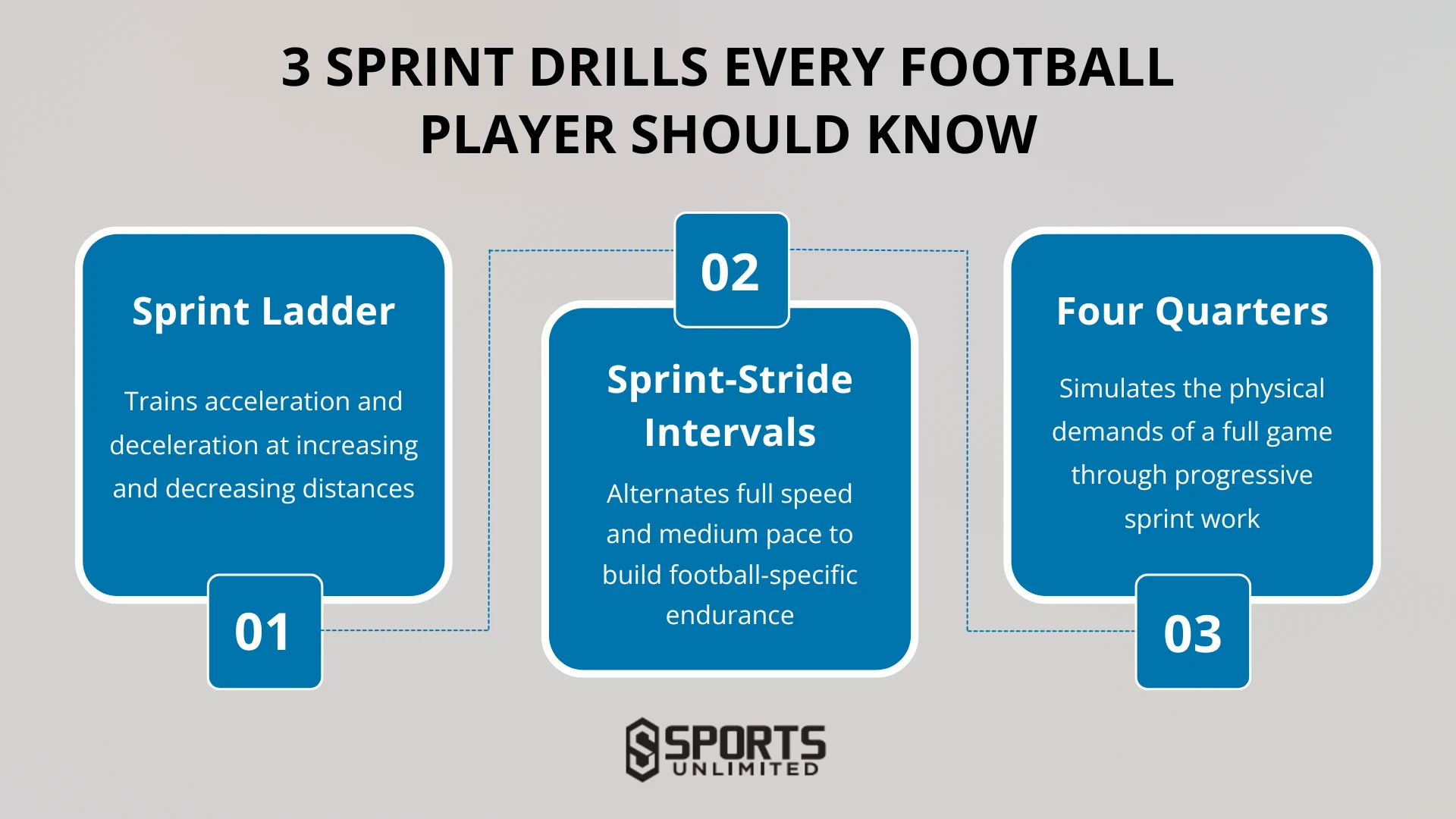
Sprint Ladder
Players run pairs of sprints at increasing then decreasing distances, starting at 10 yards and working up to 50 yards before coming back down: 10, 20, 30, 40, 50, 40, 30, 20, and 10 yards. Starting at the goal line, run each sprint from a stationary start at full speed, resting 30 seconds between reps.
The Purpose: The sprint ladder builds leg strength, speed, and coordination while training players to accelerate and decelerate repeatedly at different distances.
Sprint-Stride Intervals
Players alternate between 20-yard sprints at full speed and 20-yard strides at medium intensity for the full length of the field. Rest 30 seconds between sets, starting with four sets and working up to ten as conditioning improves.
The Purpose: Sprint-stride intervals train players to shift between peak speed and recovery pace within the same rep, building the football-specific endurance needed to perform at game time.
Four Quarters
This progressive sprint drill simulates a full game. One quarter consists of four 10-yard sprints with 10 seconds rest, four 20-yard sprints with 20 seconds rest, four 30-yard sprints with 30 seconds rest, then alternating 20-yard sprints and strides for the full field.
The Purpose: Four quarters builds football-specific endurance by forcing players to sustain effort through fatigue, the same way they would need to perform in the fourth quarter of a game.
Agility and Footwork Drills
Football players rarely run in straight lines for extended periods, which is why agility drills are such an important part of preseason conditioning. Drills that train coordination, balance, and change of direction transfer directly to in-game situations.
Ladder Drill
Set up an agility ladder flat on the ground. Players step through each rung using a different technique per pattern: single steps, lateral shuffles, in-and-out movements, and two-feet-per-rung progressions. Run each pattern twice before moving to the next.
The Purpose: Ladder drills develop quick feet, coordination, and the precise foot placement needed for route breaks, defensive shuffles, and blocking.
Cone Weave Drill
Set up six to eight cones in a straight line, spaced two yards apart. Players sprint through the cones, making a quick turn at each one while staying low. Add a sprint to the end zone after the final cone to simulate finishing a play.
The Purpose: The cone weave trains sharp directional changes, body control, and the explosive lateral cuts used by every position on the field.
Backpedal-to-Sprint
Players start in an athletic stance and backpedal five yards. On a coach's signal, they plant, drive forward, and sprint 10 yards at full speed. This drill works best when the signal is unpredictable so players react rather than anticipate.
The Purpose: Backpedal-to-sprint trains the transition from backward to forward movement, which is something defensive backs do on nearly every passing play.
Position-Specific Conditioning
Not every position demands the same physical output. Running specific drills tailored to each position makes training more useful and helps players develop the fitness they need on game day.
- Quarterback: Drop-back footwork drills and over-the-middle route work with a sprint finish to simulate throwing on the move.
- Wide Receiver: Route running with cone intervals and sprint ladder work to build the speed and precision needed to create separation.
- Running Back: Cone cuts with explosive sprint finishes and jump cuts to train the directional changes used at the line of scrimmage.
- Offensive Lineman: Sled pushes, barrel drills, and kick slide progressions that build drive strength and lateral footwork.
- Defensive Back: Backpedal-to-sprint transitions and cone reaction drills that replicate read-and-react coverage movements.
- Defensive Lineman: Get-off drills and pursuit angle sprints that train first-step explosion and the angles needed to chase down ball carriers.
Building a Safe and Effective Preseason Program
Progress Gradually
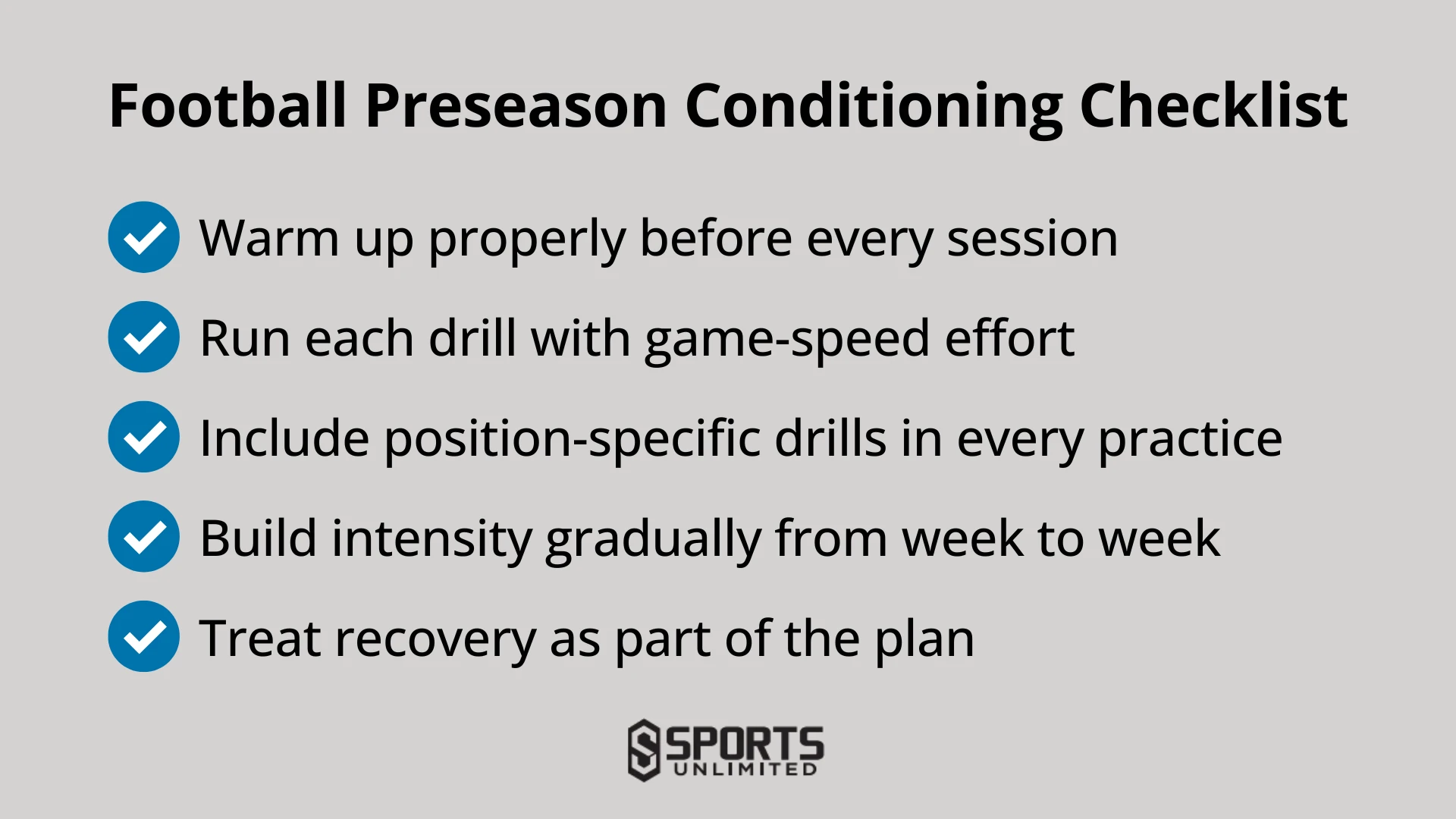
Preseason conditioning should increase in intensity over time, not hit maximum effort on day one. Athletes returning after an offseason need time to adapt before handling high volumes of sprint work. Build the program week by week, adding reps and intensity until players adapt to the training routine.
Tennessee Orthopaedic Alliance's sports medicine program notes that fatigue is one of the leading contributors to preseason injury, making recovery just as important as the drills themselves.
Build Recovery Into the Plan
Cool-downs, hydration, and post-training nutrition play a bigger role in conditioning than many players realize. Skipping recovery between sessions allows fatigue to build up, which reduces performance and raises the chance of injury. A well-structured preseason plan accounts for both how hard players train and how well they recover.
- Cool-down: Five to ten minutes of light jogging and static stretching after every session helps reduce soreness and lower heart rate gradually.
- Hydration: Water breaks should happen throughout practice, not just at the end. Heat and humidity during preseason make hydration especially important.
- Nutrition: Post-training nutrition that includes protein and carbohydrates supports muscle repair and helps players recover faster between sessions.
- Rest days: At least one full rest day per week allows the body to adapt to the training load rather than break down from it.
Sports Unlimited: Gear Up for Preseason
Getting through preseason conditioning requires equipment that fits, performs, and holds up through weeks of intense practice. Sports Unlimited has been equipping football players and programs since 1983, carrying helmets, shoulder pads, and accessories from the top brands in the game.
Orders placed before 3 PM ship the same day, and select products qualify for free 2-day shipping. For teams ordering in bulk, Sports Unlimited handles team quotes directly. Browse the full football gear lineup and head into preseason ready to work.
Frequently Asked Questions
What are the best football conditioning drills for preseason?
Sprint ladders, sprint-stride intervals, the four quarters drill, and agility ladder work are among the most effective drills for preseason. The best program combines sprint-based conditioning with footwork and agility drills rather than relying on long-distance running alone.
How long should preseason conditioning sessions last?
Most preseason conditioning sessions run 45 minutes to an hour, including warm-up and cool-down. Early in preseason, sessions should be shorter and less intense, with volume and intensity increasing gradually over the following weeks.
Should conditioning be position-specific in preseason?
Yes. Position-specific conditioning makes the training more relevant and prepares players for the actual demands of their role. Linemen benefit from different drills than defensive backs or wide receivers. Mixing position-specific work into the broader conditioning program gives players better preparation for game situations.
How do you avoid overtraining during preseason?
Build intensity gradually, include rest days, and pay attention to signs of fatigue like declining sprint times, soreness that does not improve, or reduced focus during practice. Fatigue is one of the leading contributors to preseason injury, so recovery needs to be treated as part of the training plan.
Are conditioning drills useful for youth football players?
Yes, with adjustments for age and development level. Youth football players benefit from the same basic conditioning principles but should work at shorter distances, lower volumes, and with more recovery time between reps. Fun and engagement matter too, as younger athletes stay more focused and work harder when drills are competitive and varied.