
Football Drills by Position: A Complete Practice Guide
Posted by Lou Rusnock on May 19th 2026
- Why Position-Specific Drills Matter
- Quarterback, Running Back, and Wide Receiver Drills
- Offensive Line Drills
- Defensive Player Drills
- Building a Practice Plan That Gets Results
- Sports Unlimited: Gear Built for Practice and Game Day
- Frequently Asked Questions
The Short Answer: The best football practice drills are position-specific, replicate real game movements, and combine skill work with conditioning. Key examples include dropback footwork drills for quarterbacks, ball security gauntlets for running backs, and release drills for wide receivers.
Every football coach wants players who are faster, sharper, and better prepared come game day. The problem is that too many practice plans rely on generic exercises that don't reflect what players actually do on the field. A wide receiver and an offensive lineman have almost nothing in common in terms of movement, so why would they train the same way?
Why Position-Specific Drills Matter
Position-specific drills close the gap between practice and game situations. When a drill replicates a real movement, it builds both muscle memory and football instinct at the same time. That combination is what makes the difference between players who look sharp in warmups and those who perform when it counts. This guide breaks down the most effective football drills by position and what each one is targeting.
Quarterback, Running Back, and Wide Receiver Drills
Quarterback Drills
The best QB drills train decision-making and footwork under pressure at the same time, not just throwing mechanics.
- Dropback footwork drill: The QB takes a 3, 5, or 7-step drop while a coach calls out a coverage indicator at the top of the drop. The QB reads and throws to the correct side. This trains proper footwork and quick decisions simultaneously.
- Pocket movement drill: Two cones simulate a collapsing pocket. The QB drops, steps up, resets their base, and delivers. Run at full speed to replicate real game pressure.
- Rapid fire drill: Two or three receivers line up at different depths. The QB cycles through quick throws in succession. This builds arm endurance and reinforces a quick release.
Running Back Drills
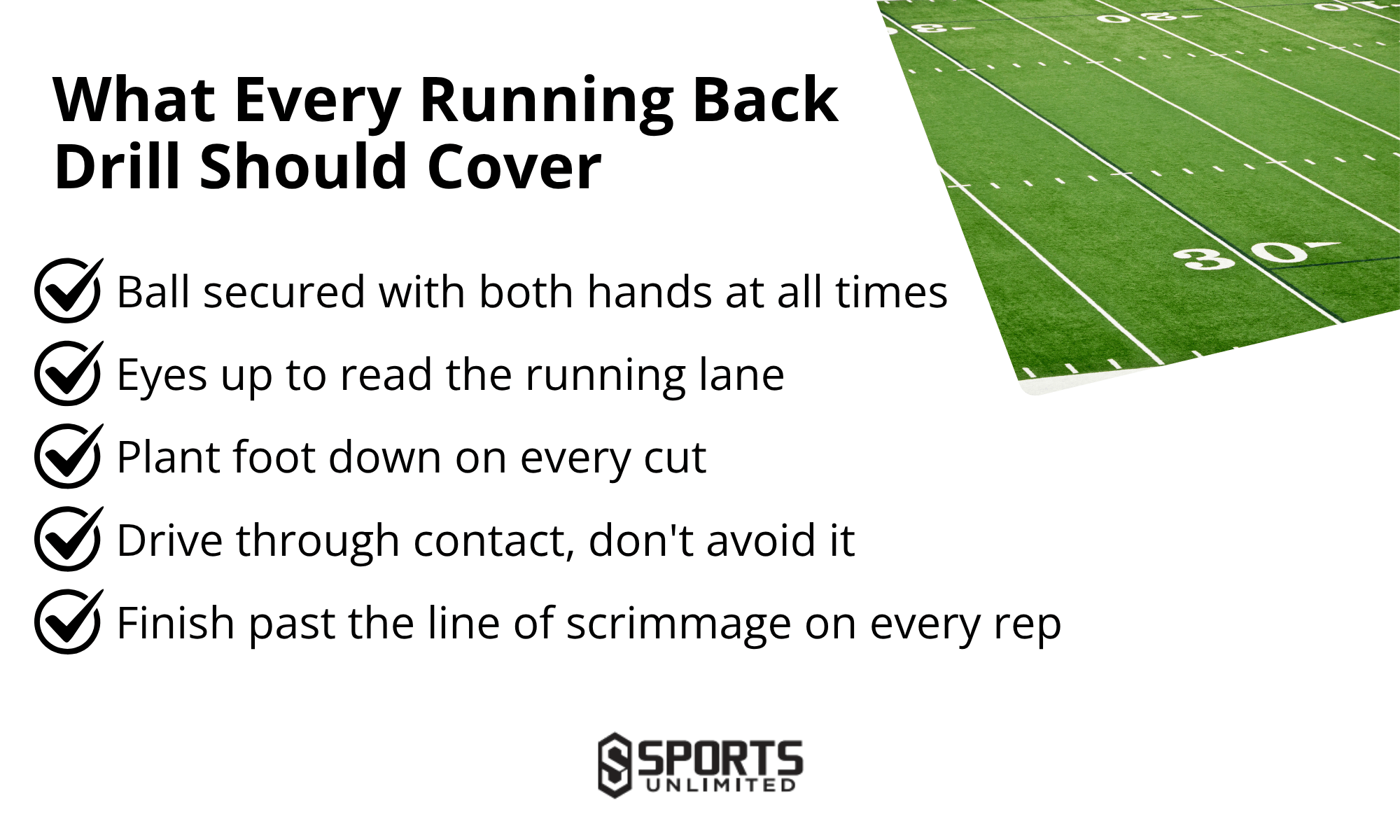
Running backs need drills that combine ball security, quick cuts, and explosive finishes. Speed in a straight line means nothing if a back fumbles or hesitates at the line.
- Ball security gauntlet: The back runs through a line of players attempting to strip the ball while keeping both hands secured. Run at full speed.
- Cone cut drill: Cones simulate a running lane with cutback options. The back reads the first cone as a block and makes a sharp cut. Emphasize proper footwork on the plant rather than just speed.
- Finish through the line drill: A pad is placed five yards past the line of scrimmage. The back must run through contact and finish past the marker on every rep.
Wide Receiver Drills
Wide receivers need route reps at game speed with enough volume to build endurance and precision. Running routes at half speed builds habits that fall apart against a defensive back pressing at full speed.
- Release drill: A defensive back jams the receiver at the line. The receiver works through using an inside or outside release before running the route. This simulates man coverage from the first step.
- Route and catch drill: Receivers run a full route sequence, catching the ball at the break point of each route. The goal is precision and consistency across multiple reps.
- Concentration catch drill: A coach or defender distracts the receiver at the catch point. This builds focus and hands reliability under game-like conditions.
Offensive Line Drills
Offensive linemen often get less drill time than any other position on youth football teams, so every rep needs to count. Improvement comes from drilling specific movements repeatedly, and every blocking drill should connect directly to plays in the offensive scheme. For a deeper look at the fundamentals every lineman should know, USA Football's guide to offensive line fundamentals is a strong coaching resource.
Footwork and First Step
- Kick slide drill: The lineman sets in a pass protection stance and executes a kick slide right, then resets and slides left. Focus on keeping the base wide and weight balanced through each rep.
- Mirror drill: Two linemen face each other. One leads with lateral movement, the other mirrors. This builds the lateral quickness needed in pass protection against a rushing defensive player.
Blocking Drills
- Drive block drill: The lineman fires out of their stance on the snap, makes contact with a pad or defensive player, and drives them five yards off the line. Focus on pad level, hand placement, and leg drive.
- Pass set and punch drill: The lineman executes a pass protection set and delivers a punch into a blocking pad. Run at full speed with correct hand placement on every rep.
- Double team block drill: Two linemen combination block a single defensive lineman, then one releases to the second level. This trains communication and timing between linemen.
Defensive Player Drills
Defensive drills should build reaction speed, pursuit angles, and quick reads. The best defensive drills force players to react to a visual or verbal cue rather than anticipate the snap.
Defensive Line Drills
- Get-off drill: The defensive lineman fires on a visual cue rather than a cadence count. This trains the player to read the ball and eliminates false starts.
- Swim and rip drill: The lineman works through a blocker using a swim or rip move to reach the backfield. Run against a live offensive lineman at full speed.
- Pursuit angle drill: A cone represents the ball carrier's path. The lineman takes the correct pursuit angle to cut off the ball rather than chasing from behind. This is one of the most overlooked drills at the youth football level.
Defensive Back Drills
- Backpedal and break drill: The defensive back starts in a backpedal, reads a cue from the coach, then drives forward or breaks on a diagonal to simulate reacting to a route.
- Interception drill: The defensive back tracks balls thrown at varying depths and angles, catching at the highest point. Run at game speed with a receiver nearby to simulate a contested catch.
- Man coverage trail drill: The defensive back mirrors a receiver's route from a trail position. This builds hip and footwork fundamentals for man coverage.
Building a Practice Plan That Gets Results
Structure and Pace
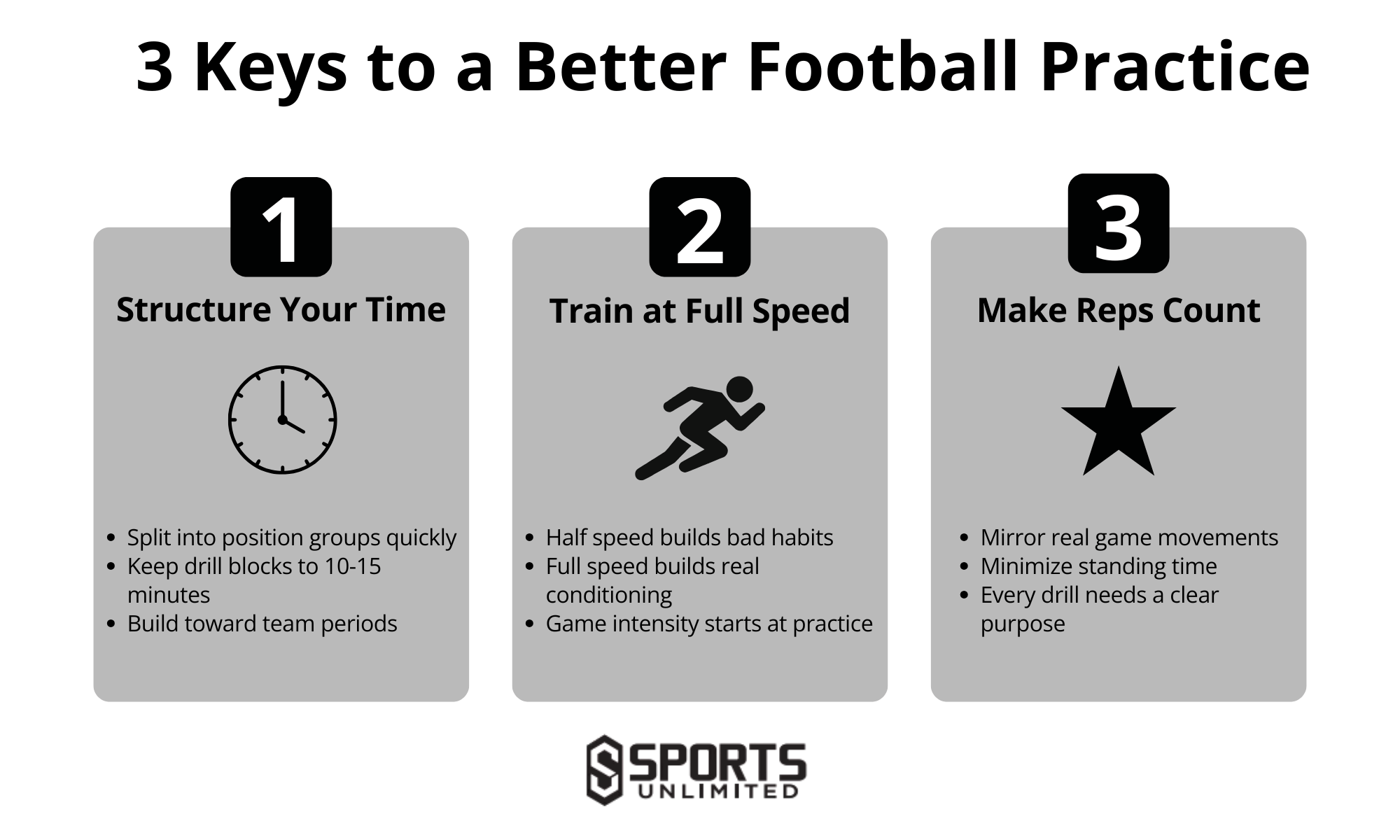
Fast-paced practices with minimal downtime keep players engaged and produce more quality reps. When young players stand around waiting for their turn, focus drops and the value of each rep declines. Split into position groups quickly after warm ups, keep individual drill blocks to 10 to 15 minutes, and build toward team periods where position-specific skills get applied together in game situations.
Conditioning Through Drills
Separating skill work from conditioning is outdated, as running a mile or doing bear crawls at the end of practice builds general fitness but doesn't translate to game performance. The better approach is running drills at full speed with short rest periods so players build conditioning and football skills in the same rep. USA Football's National Practice Guidelines recommend that youth football practices focus on teaching proper technique at game speed rather than isolating conditioning as a separate activity.
Sports Unlimited: Gear Built for Practice and Game Day
The right equipment makes every drill more effective. Blocking pads that compress too quickly, helmets that don't fit, and worn-out shoulder pads all affect the quality of practice reps. Sports Unlimited has been equipping football players and teams since 1983, and offers helmets, shoulder pads, and training equipment from top brands for both youth teams and high school programs.
Browse the full football equipment lineup at Sports Unlimited and make sure your players are geared up to get the most out of every rep.
Frequently Asked Questions
What are the most important football drills for youth players?
The most important drills for youth football players are ones that teach proper technique in positions they actually play. Footwork drills, ball security work for ball carriers, and reaction drills for defensive players build the foundational skills that carry through to higher levels of the game.
How long should football practice drills last?
Most individual position drills should run between 10 and 15 minutes. Short, focused blocks with high rep counts and minimal standing time produce better results than longer sessions where players lose focus.
Should conditioning be separate from football drills?
Not if you can avoid it. Running drills at full speed with short rest periods builds football-specific conditioning while reinforcing proper technique. Separating conditioning into standalone running sessions is less effective for football development.
What drills work best for flag football players?
Flag football players benefit most from route running drills, quick release work for quarterbacks, and flag pulling technique for defenders. Since flag football removes blocking and tackling, the focus shifts to footwork, speed, and catching.
How do you structure an effective youth football practice?
Start with a structured warm up, move quickly into position groups, and build toward team periods. Keep transitions short, maintain a fast pace, and make sure every drill has a clear purpose tied to what players will do in a game.