
How to Read a Football Defense Before the Snap
Posted by Lou Rusnock on Sep 2nd 2026
- Start With the Safeties
- Count the Box
- Check the Cornerbacks and Linebackers
- Watch for Disguise
- Putting It All Together: A Pre-Snap Scan Order
- Common Mistakes When Reading a Defense
- Sports Unlimited: Gear Up to Play Faster
- Frequently Asked Questions
The Short Answer: Reading a defense in football means scanning the field before the snap to predict what the opposing unit will do. Start with the safeties, then count the box, check the cornerbacks, and watch for disguise. Following the same scan order each time makes a complex defense much easier to read.
Reading the defense before the snap is one of the most important skills for any offensive player. A quarterback who can identify what the defense is showing gains a major advantage, while the same skill helps running backs find the right hole and receivers recognize coverage.
Start With the Safeties
One of the most useful pre-snap reads is identifying the number of deep safeties. According to the NFL's official glossary, a safety is the defensive back who lines up deepest in the secondary. Count how many safeties are lined up roughly ten to fifteen yards off the ball before the snap.
- One deep safety (one-high): The middle of the field is closed, which often signals man coverage or a single-high zone like Cover 1 or Cover 3. It usually means the defense has an extra defender near the box to help against the run.
- Two deep safeties (two-high): The middle of the field is open, pointing to coverages like Cover 2 or Cover 4. It often means the defense has one fewer defender available against the run.
- No deep safeties: Both safeties are near the line. Expect a blitz or all-out pressure, though this can also be a disguise.
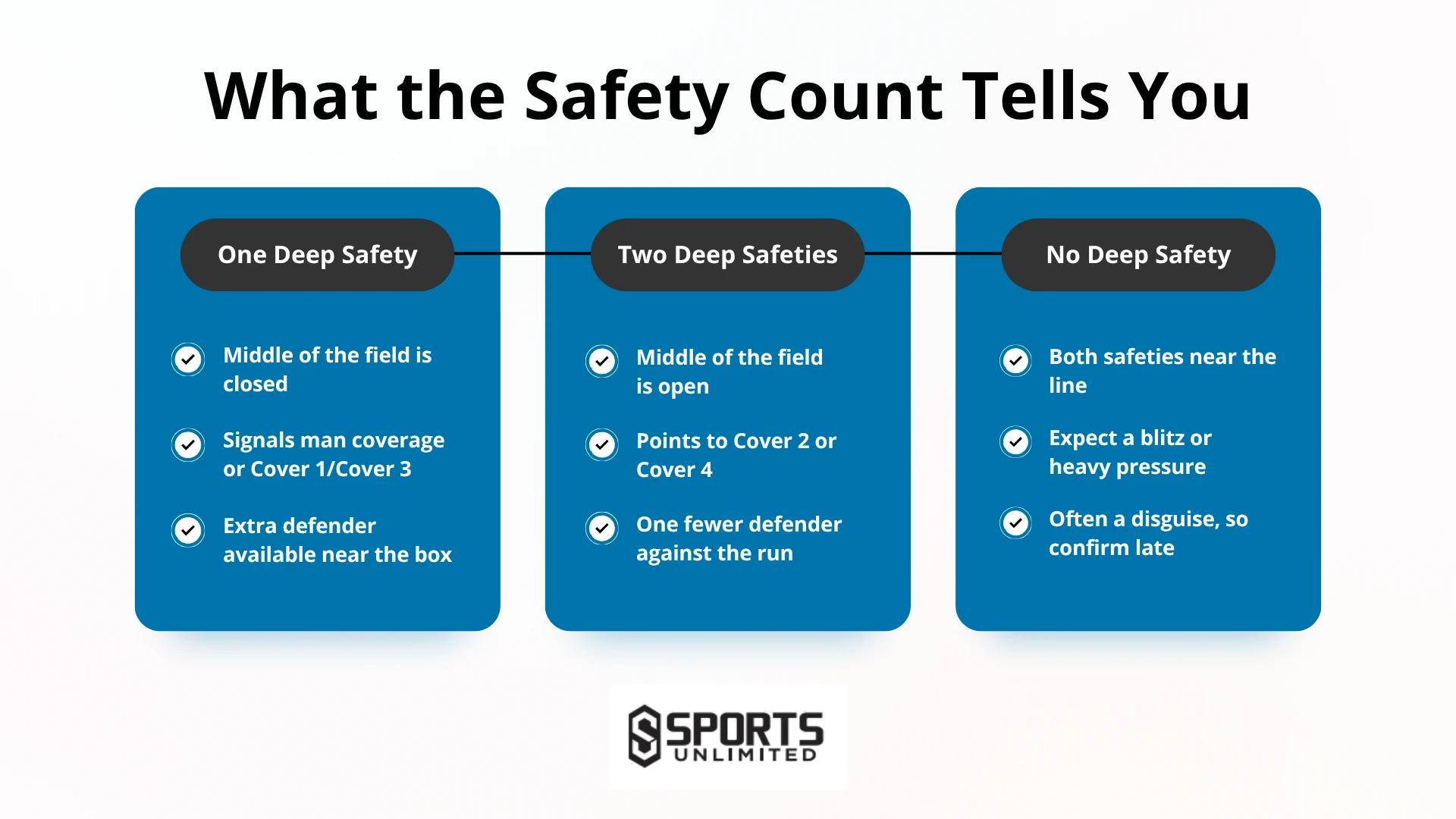
This one read narrows the possibilities dramatically before you look anywhere else.
Count the Box
The box is the area between the offensive tackles, extending about five yards back, where the offensive line sets up. Counting the defenders there, usually the defensive line and linebackers, tells you whether the unit is set up to stop the run or guard against the pass. Watch for a defensive lineman shading toward a gap or an offensive lineman revealing the run direction with his stance, then compare the box number to the offense's blockers. If the defense has more players in the box than the offense can block, a pass may be the better call. If the box is light, the offense has more blockers than defenders, giving the run a better chance.
- Six or fewer: A light box. The defense is likely playing pass first, which can favor the run.
- Seven: A neutral look that can defend either the run or the pass.
- Eight or more: A loaded box. The defense is committed to stopping the run, which can open up the pass, including a quick throw over defenders crowding the line. Watch whether a defensive end drops into coverage instead of rushing, which is a sign of a zone blitz.
Box count and safety alignment work together. A one-high look usually adds a defender to the box, while a two-high look takes one away. Recognizing common defensive formations like the 4-3, 3-4, and nickel also helps you predict how many defenders will crowd the box.
Check the Cornerbacks and Linebackers
Cornerback Alignment
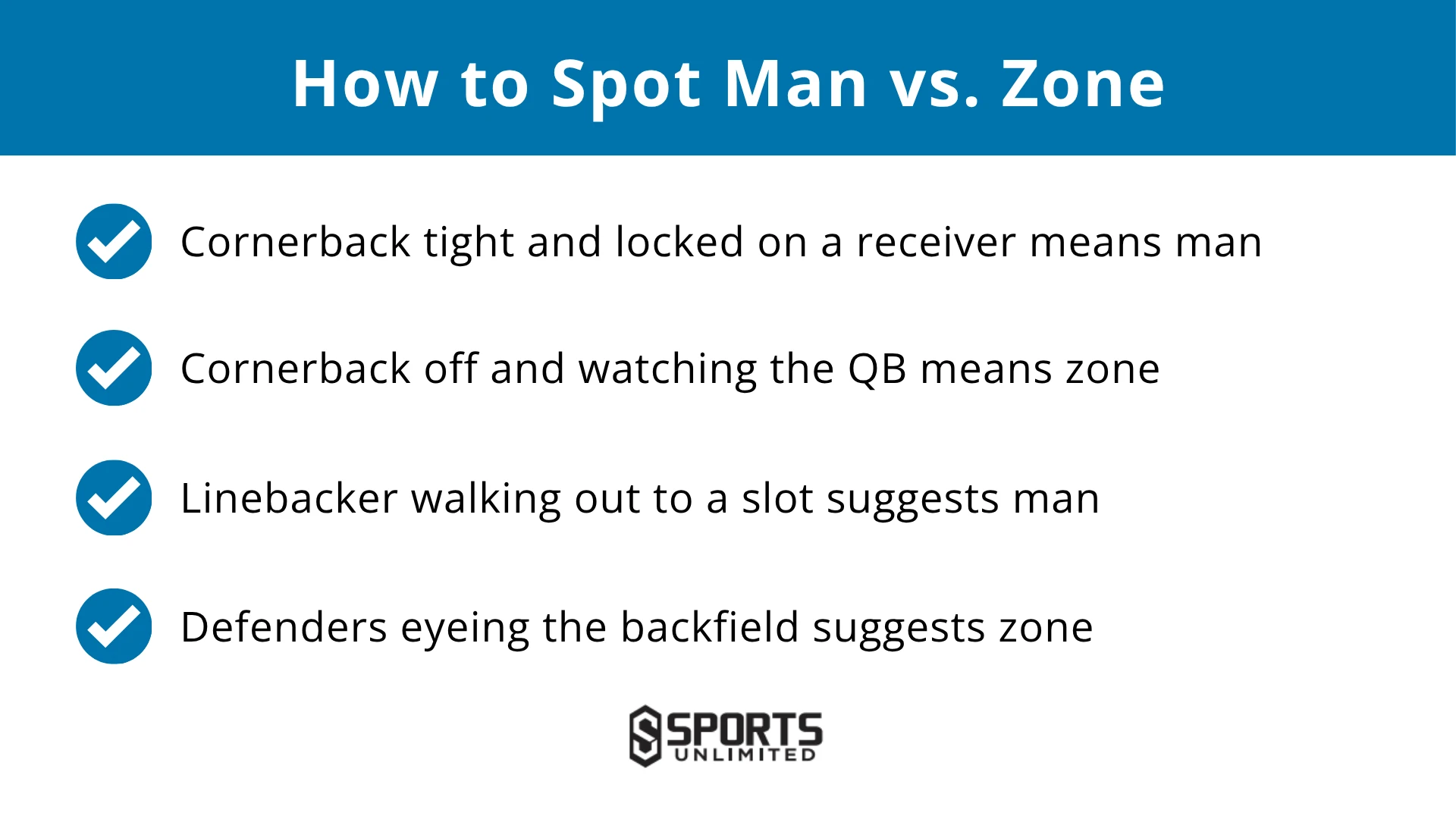
Cornerbacks give away coverage through alignment. Press alignment, directly over a wide receiver at the line, often signals man coverage or aggressive zone. Off alignment, five to eight yards back, often signals zone coverage.
Where the Cornerback Looks
Also watch where the cornerback looks. A defender locked onto the receiver is often in man coverage, while one watching the quarterback and backfield is often in zone. Zone defenders read the quarterback's actions rather than following a single receiver.
Linebacker Depth and Width
Linebackers can provide clues about both run and pass intentions. Movement toward the line of scrimmage may signal a blitz or a plan to fill run gaps, while dropping back or widening often indicates a zone responsibility or a matchup with a tight end or running back. A player who walks out to cover a slot receiver may indicate man coverage on that side of the field.
Watch for Disguise
Good defenses use disguise to avoid revealing their intentions before the snap. They may show one defensive coverage look and rotate into another to confuse the quarterback, making an early read unreliable. This is where many beginners get fooled.
The trick is timing. Make an early read before the snap, then take a final look in the last couple of seconds when defenders move into their final alignment. Watch for these late tells:
- Safety rotation: A two-high look can rotate to one-high at the last second, or the reverse. Watch the safeties' feet.
- Choppy versus smooth steps: Short, choppy steps often mean a safety is about to drive downhill, signaling a blitz or run support. Smooth backpedal steps usually mean deep coverage.
- Late movement: Defenders creeping toward the line or bailing to deep zones late are showing their true intent right before the snap.
The defense has to be honest eventually. Someone must cover the deep pass and fill the run gaps, so the real picture shows up in the final moment.
Putting It All Together: A Pre-Snap Scan Order
Reading a defense can feel overwhelming when you try to see everything at once. A scan order fixes that. Here is a simple sequence to repeat on every play.
| Step | Where to Look | What It Tells You |
|---|---|---|
| 1 | Safeties | The safety count narrows the coverage family. |
| 2 | The box | The defender count shows a run or pass lean. |
| 3 | Cornerbacks | Their alignment and eyes reveal man or zone. |
| 4 | Linebackers | Their depth and movement hint at blitz or coverage. |
| 5 | Final read | Late movement confirms or exposes disguise. |
With practice, this scan takes only a few seconds and becomes automatic. It holds up at full speed on game day, and the picture comes into focus faster each time.
Common Mistakes When Reading a Defense
When learning to read a defense, a few common mistakes can make pre-snap decisions more difficult.
- Reading too early: Taking a final read before the defense settles leaves you open to disguise. Always take a last look right before the snap.
- Paralysis by analysis: Trying to process every defender at once leads to hesitation. Trust the scan order and move on.
- Ignoring run or pass balance: Focusing only on coverage and forgetting the box count leads to missed run reads, and the reverse is true too. A misread box can spring the ball carrier for a big gain.
- Not confirming after the snap: The pre-snap read is a prediction. Confirm it on the first step after the snap and adjust if the defense rotated.
Sports Unlimited: Gear Up to Play Faster
Reading a defense takes preparation and practice, and players need the right equipment to build those skills on the field. Sports Unlimited has equipped football players and programs since 1983, offering helmets, shoulder pads, and practice gear from trusted brands.
Orders placed before 3 PM ship the same day, and select products qualify for free 2-day shipping. Coaches can reach out for bulk and team orders. Browse the full football lineup and get equipped for the season.
Frequently Asked Questions
What should you look at first when reading a defense?
Start with the safeties. Counting how many are deep, whether one or two, immediately narrows the likely coverage. From there, count the box, check the cornerbacks, and watch the linebackers.
How do you tell man coverage from zone coverage?
Watch the cornerbacks. A cornerback lined up tight and focused on a receiver is often in man coverage, while one playing off and watching the quarterback is often in zone. Safety count and linebacker movement help confirm the read.
What does a one-high safety look mean?
One deep safety means the middle of the field is closed, often pointing to coverages like Cover 1 man or Cover 3 zone. It can also mean an extra defender near the box against the run.
How long does it take to get good at reading defenses?
It takes time and repetition, but the scan order speeds up the process. Practice one basic read at a time, like safety count, then add the next layer until the full scan becomes automatic.