
Wide Receiver Drills and Training Guide for Route Running, Speed, and Catching
Posted by Lou Rusnock on Jul 9th 2026
- Beat Press Coverage With Release Drills
- Route Running Drills for Sharp Cuts and Separation
- Catching Drills for Hands, Tracking, and Traffic
- Speed and Footwork Drills for Explosiveness
- Gear Up for Wide Receiver Training at Sports Unlimited
- Frequently Asked Questions
The Short Answer: The best wide receiver drills build four skills in order: a clean release off the line of scrimmage, precise routes with sharp cuts, reliable hands, and speed you can control. Train release, route running, catching, and footwork on their own, then put them together at full speed against a defender.
Great receivers are made on the practice field. Speed and soft hands help, but the players who get open every snap are the ones who win the small battles. The first step off the line, the plant at the top of the route, and the catch through contact decide most plays.
Beat Press Coverage With Release Drills
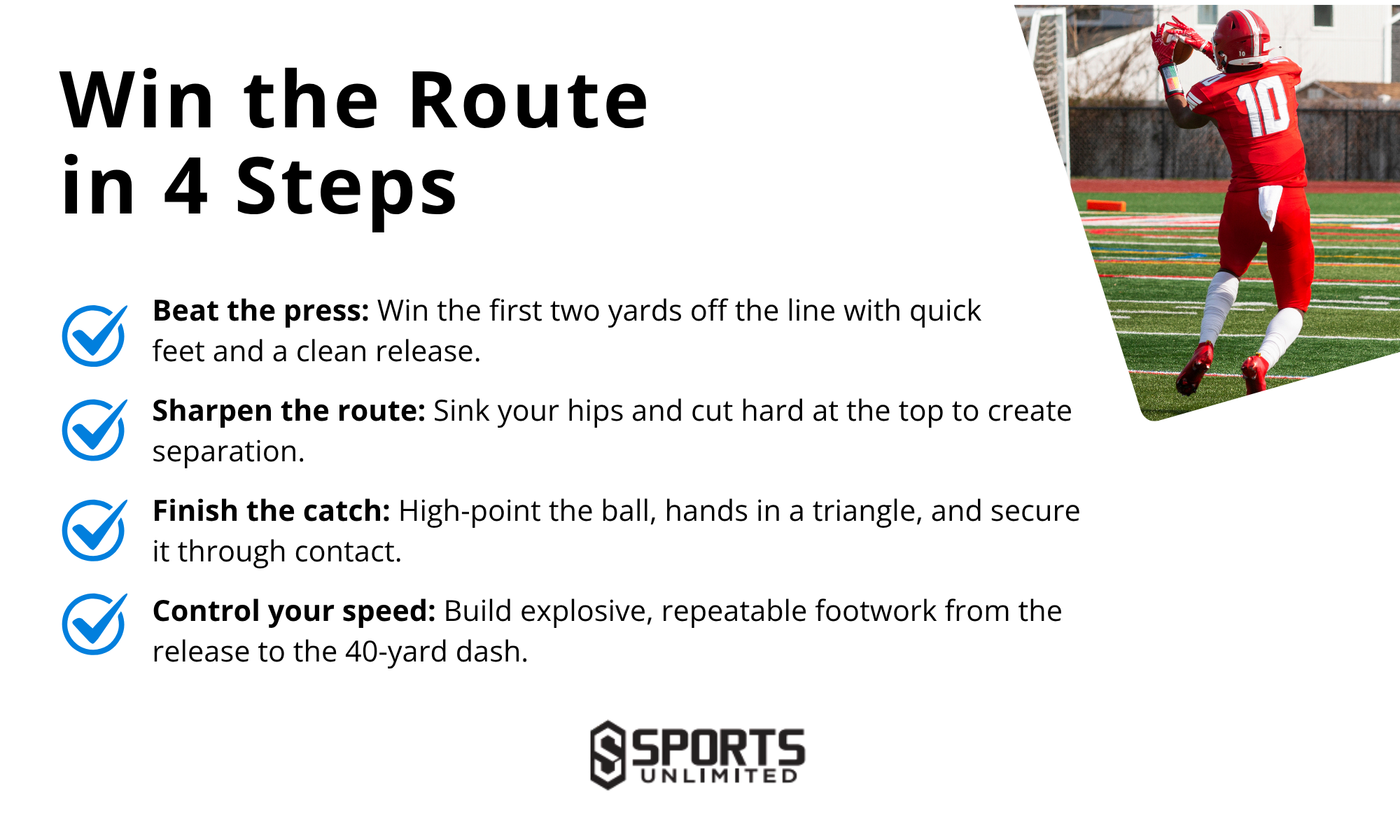
The route starts before the snap. Against press coverage, a receiver has to win the first two yards off the line of scrimmage, or the timing and spacing of the route can break down. These wide receiver drills train footwork, hand fighting, and leverage so the athlete can earn a clean release every rep.
1. Mirror Release Drill
- Focus: Footwork and hand fighting against a defender at the line.
- Setup: Put a defender head-up on the receiver. On the snap, the player uses a quick jab step and a hand swipe to clear the defender's hands, then accelerates past.
- Coaching cue: Win with your feet first. The hands clear contact, but the feet create separation.
2. Two-Way Go Drill
- Focus: Releasing to either side so a defensive back cannot guess.
- Setup: The receiver releases inside on one rep and outside on the next, off the same stance. Mix the order so the defensive back has to honor both an inside receiver and an outside receiver look.
- Coaching cue: Sell the same first step on both releases. The harder the stem looks, the more the defender opens his hips.
Route Running Drills for Sharp Cuts and Separation
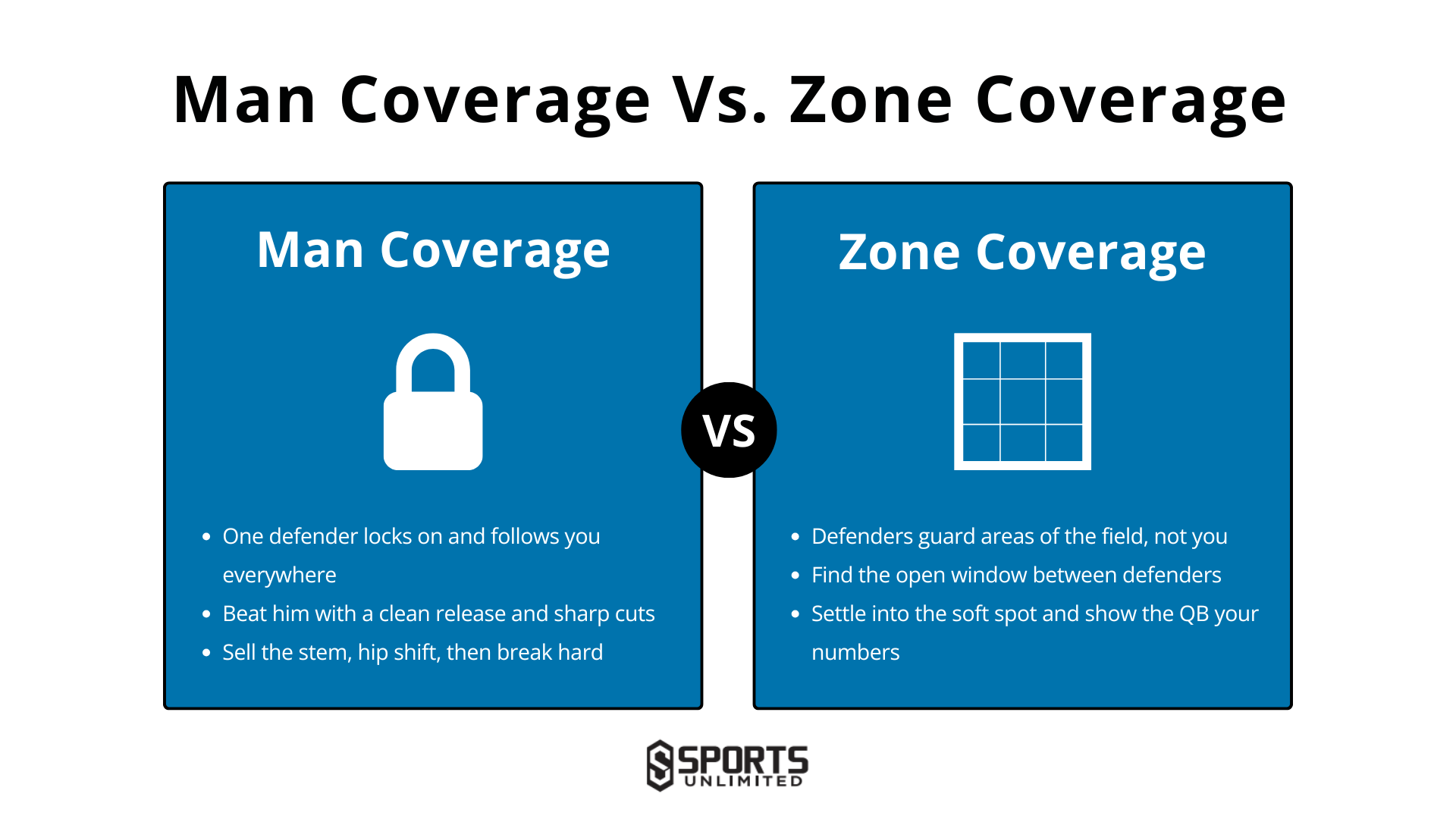
Speed gets a receiver down the field, but route precision is what creates separation. Most separation is created at the top of the route, where a sharp cut and a quick change of pace force the defender to react a step late. These drills sharpen cuts, body control, and the decelerate-then-accelerate move that wins routes.
3. Four-Cone Cut Drill
- Focus: Sharp cuts at game speed without drifting.
- Setup: Set four cones in a five-yard box. Explode to a cone, sink the hips, plant the outside foot, and cut at a 45 or 90-degree angle. Switch the starting cone to work both directions.
- Coaching cue: Chop the feet and sink before the cut. Rounded cuts give the break away.
4. Top-of-Route Speed Cut
- Focus: Creating separation with controlled deceleration and explosive acceleration.
- Setup: The receiver runs a 10-yard stem, brakes hard for two steps at the break, then accelerates out of the cut. A coach or quarterback delivers the ball as the receiver clears.
- Coaching cue: Win at the top of the route. The brake is the move; the throttle is the finish.
5. Aiming Point Route Drill
- Focus: Running every route to the same depth and aiming point.
- Setup: Mark route depths with cones at different angles. The player hits the landmark, breaks, and looks the football in. Run the full route tree so each pattern looks identical off the release.
- Coaching cue: Same stem, same depth, every time. A predictable stem for the receiver means an unpredictable break for the defender.
Coaches who want a deeper look at winning the break can study route separation techniques from USA Football, which break down hip shifts and timing at the top of the route. A wide receiver coach can use video of each rep to show players when they drift or tip a route.
Catching Drills for Hands, Tracking, and Traffic
A clean route is only valuable if it ends with the catch. Catching drills should replicate game situations, including high-pointing the ball, securing catches in traffic, and finishing through contact. Every rep should emphasize hand placement, hand-eye coordination, and ball tracking.
6. High-Point and Contested Catch Drill
- Focus: Catching above the defender and making difficult catches in traffic.
- Setup: A quarterback throws jump balls while a partner contests with a pad. The receiver attacks the ball at its highest point, uses strong triangle hands, and secures it through contact.
- Coaching cue: Catch the ball first, then absorb the contact. Pluck it away from the body with strong hand placement.
7. Tennis Ball Reaction Drill
- Focus: Hand-eye coordination and reaction quickness.
- Setup: A partner stands a few yards away and tosses two tennis balls, one at a time, from different angles. The receiver tracks and catches each tennis ball one-handed, then resets. Call a number on the tennis ball to sharpen focus.
- Coaching cue: Eyes to the tennis ball, soft hands, quiet feet. Small target, big focus.
8. Over-the-Shoulder Tracking Drill
- Focus: Tracking the deep ball over either shoulder.
- Setup: The receiver sprints downfield while the quarterback lofts a pass over the left or right shoulder. He turns his head late, finds the ball, and finishes the catch in stride like a ball carrier breaking upfield.
- Coaching cue: Eyes on the ball early, soft hands at the catch point, quiet feet.
Speed and Footwork Drills for Explosiveness
Speed wins routes only when it is under control. Footwork drills build the explosiveness and change of direction needed for everything from the release off the line to the 40-yard dash. Many of these movements mirror on-field tests at the NFL Scouting Combine.
9. Agility Ladder Series
- Focus: Foot speed, rhythm, and change of direction.
- Setup: Run the ladder through in-and-outs, lateral shuffles, and single-leg hops. Finish each pass with a five-yard sprint so the feet connect to real acceleration.
- Coaching cue: Fast feet, tall posture. The ladder trains quickness; the sprint trains the payoff.
10. Gauntlet and 40-Yard Dash Drill
- Focus: Catching on the move and straight-line speed.
- Setup: Run the gauntlet by sprinting a straight line while a passer feeds the football from alternating sides. Pair it with timed 40-yard dash reps to build top-end speed and a fast 10-yard split.
- Coaching cue: Hold your line and pluck each ball. The 40-yard dash measures speed; the gauntlet adds focus.
The 40-yard dash is a core test at the NFL Scouting Combine used to evaluate speed for wide receivers, tight ends, running backs, and defensive backs. While drills like the gauntlet are not official combine tests, they are widely used in training to simulate catching, tracking, and movement under pressure. These same movement patterns appear from youth flag football drills all the way through elite combine training and NFL-level evaluation.
Gear Up for Wide Receiver Training at Sports Unlimited
Wide receiver training comes down to reps, and the right gear keeps those reps productive. Sports Unlimited is a family-owned sporting goods retailer that has stocked football gear since 1983. The lineup includes football gloves for a reliable catch point, football helmets for protection, and training equipment like agility ladders and cones for footwork drills.
Parents, coaches, and athletes count on Sports Unlimited for fast, dependable service. Orders placed before 3 PM ship the same day, many with free 2-day shipping, and a deep inventory keeps full position groups stocked before the season. Coaches and program directors can request a team quote for bulk orders.
Browse wide receiver gear and training equipment at Sports Unlimited and give every athlete the tools to win at the line, at the break, and at the catch point.
Frequently Asked Questions
What are the best wide receiver drills for beginners?
Start with release footwork, the four-cone cut drill, and partner catching drills. These build the release, route, and hands a young athlete needs before adding heavy speed work.
How does a receiver create more separation?
A receiver's ability to separate shows up at the top of the route. Sharp cuts, sudden deceleration, and a quick burst out of the break beat a defender by a step. Run every route at full speed so it looks identical each time.
Do tennis ball drills really help catching?
Yes. A small, fast-moving tennis ball sharpens hand-eye coordination and forces soft, focused hands. The habit carries over to catching a football in traffic and on the move.
How important is the 40-yard dash for a wide receiver?
Straight-line speed matters, and the 40-yard dash is the headline number for receivers at the NFL Scouting Combine. Controlled speed that holds up through a route break matters even more in a game.