
How to Choose the Right Soccer Goal Size by Age
Posted by Doug Ervin on Aug 17th 2026
- Soccer Goal Size by Age: The Chart
- Why Goal Size Matters for Player Development
- Portable vs. Fixed Soccer Goals
- What to Look for When Buying a Youth Soccer Goal
- Sports Unlimited: Soccer Goals for Every Age Group
- Frequently Asked Questions
The Short Answer: Choosing the right soccer goal size depends on the age and skill level of the players. Youth players start with smaller goals like 4x6 feet and progress to the full-size 8x24 foot goal by age 13. Using the wrong goal size can slow player development and make the game harder to learn.
Goal size is one of the most overlooked factors in youth soccer. It plays a direct role in how well young players develop shooting accuracy, positioning, and goalkeeper skills. A six-year-old playing in front of an 8x24 full-size goal is not developing the positioning habits and game sense that come from playing in front of a 4x6 goal built for their age group.
Soccer Goal Size by Age: The Chart
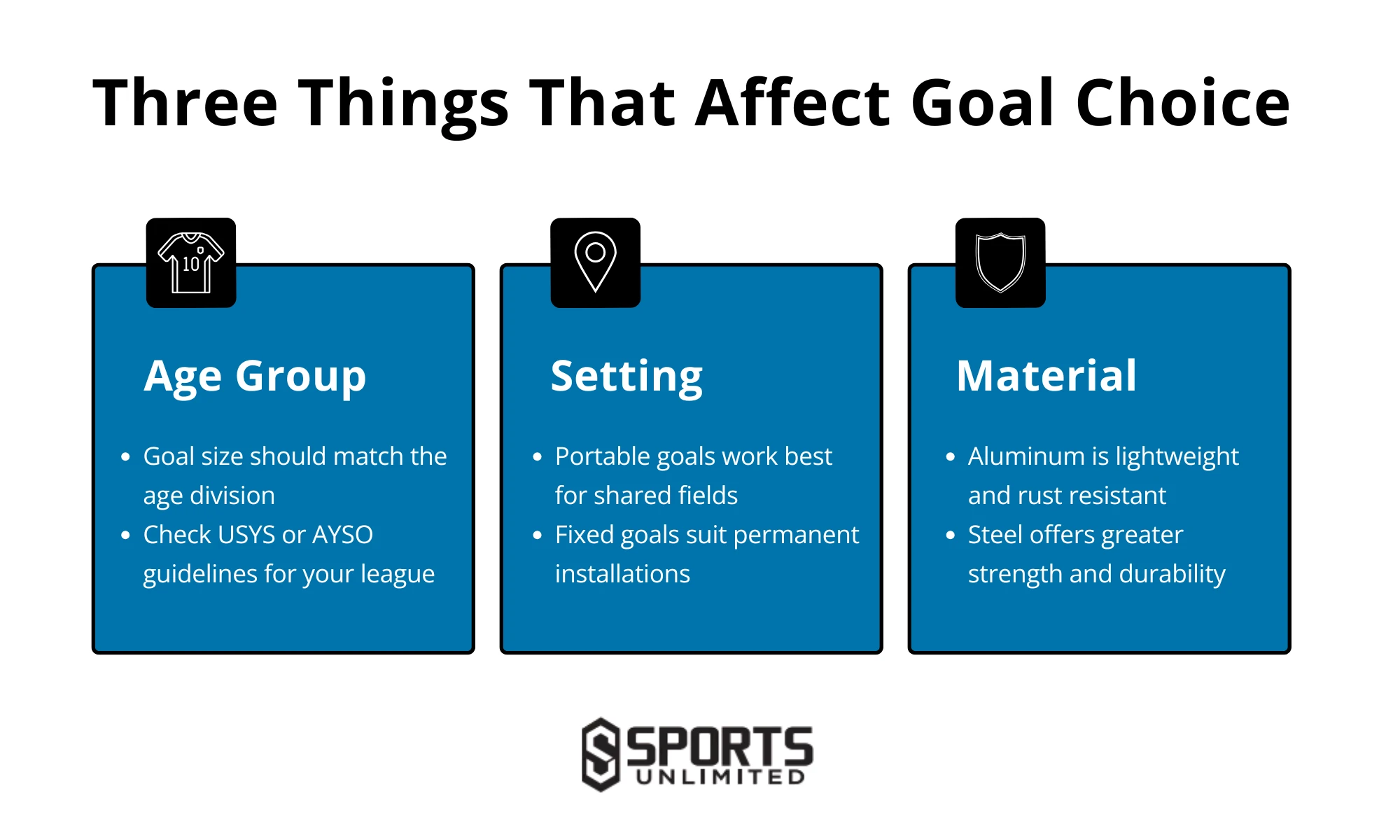
Goal size recommendations in the United States come primarily from US Youth Soccer (USYS) and the American Youth Soccer Organization (AYSO). Both organizations have established guidelines for goal dimensions at each age category, with field size also factoring into the appropriate goal for each level. Here is a general breakdown:
| Age Group | USYS Recommended Size | AYSO Recommended Size | Field Context |
|---|---|---|---|
| U6 to U8 | 4' x 6' | 4' x 6' | Small field, introductory play |
| U9 to U10 | 6.5' x 18.5' | 6.5' x 12' | Mid-size field, small-sided games |
| U11 to U12 | 7' x 21' (maximum) | 6.5' x 18.5' | Larger field, developing tactical play |
| U13 and up | 8' x 24' | 8' x 24' | Full-size, 11v11 play |
The USYS and AYSO recommendations differ across different age groups in the U9 to U12 range, which reflects different approaches to player development at those ages. Note that these reflect recommended sizes, not the maximum size allowed in all cases. Always check with your specific league before purchasing a goal to confirm which standard applies.
Why Goal Size Matters for Player Development
The Case for Smaller Goals
An oversized goal can make scoring easier for younger players, while a smaller goal encourages them to be more deliberate with shot placement. U.S. Soccer's Player Development Initiatives include age appropriate goal and field sizes as part of a broader small sided game framework. The goal is to increase player involvement, touches on the ball, and opportunities to develop decision making and technical skills as they progress.
What Is the Importance for Goalkeepers?
An 8 by 24 foot goal is simply too large for a young goalkeeper to defend effectively. When the posts are farther apart than the player can reasonably cover, goals may happen because of the keeper's physical limitations rather than a positioning or technique mistake. That makes it harder for young goalkeepers to understand what they could have done differently and use each goal as a learning opportunity.
A smaller goal gives young goalkeepers a realistic chance to make saves. In a goal that is proportional to their size, they can develop positioning, footwork, and the ability to read the game. Instead of feeling helpless as shots fly past them, they can learn from each attempt and build confidence as keepers.
What Happens When the Goal Is Too Big?
Using an oversized goal at younger ages can reinforce habits that may be difficult to correct later. Outfield players may rely on power instead of accurate placement, while goalkeepers can become passive when parts of the goal feel impossible to reach. Matching the goal size to the age group gives both players and goalkeepers a better environment for developing proper technique.
Portable vs. Fixed Soccer Goals
Once you have confirmed the right size for your age group and league, consider whether a portable or fixed soccer goal is the better fit.
Portable Soccer Goals
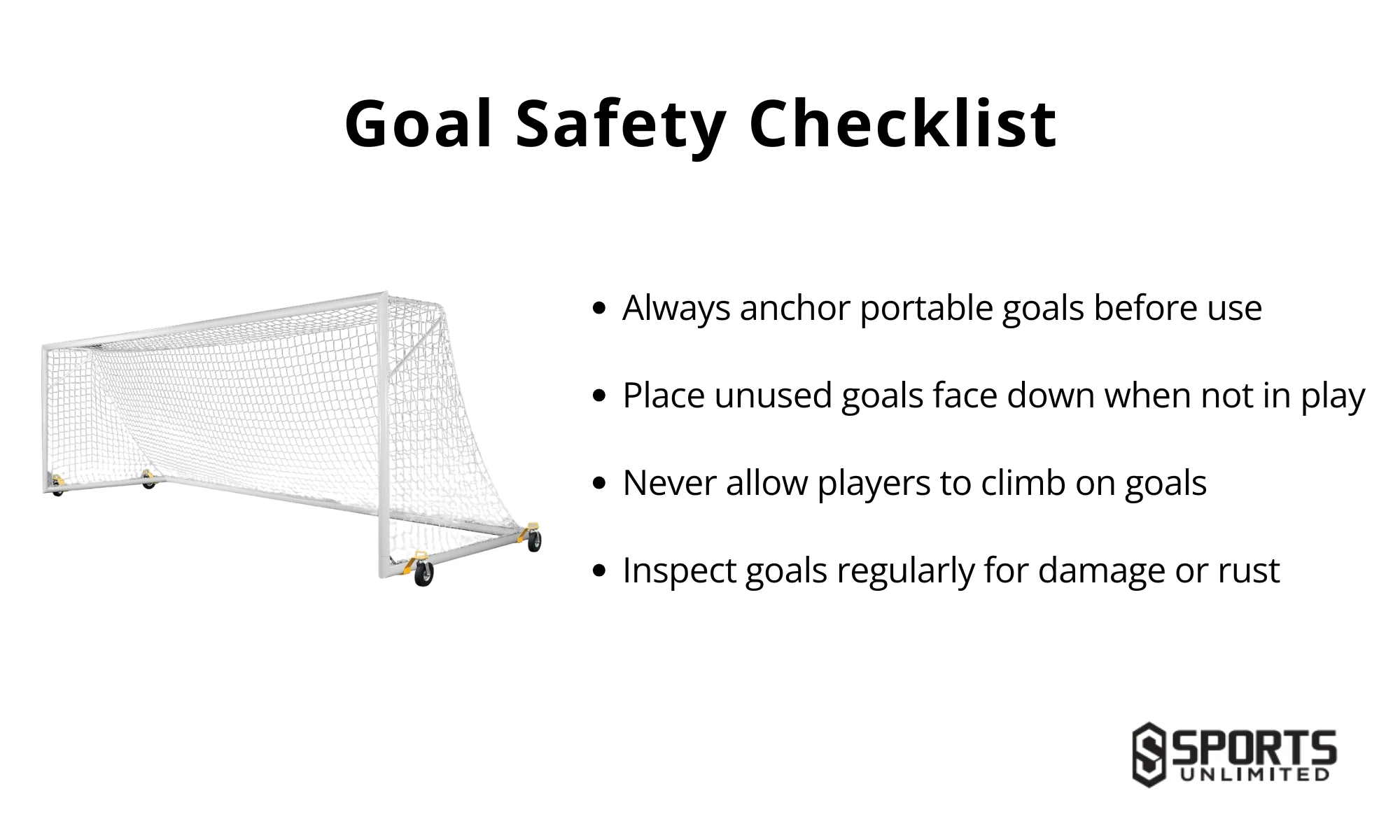
Portable goals are lightweight, foldable, and easy to move. They are the most common choice for recreational youth soccer, backyard practice, and leagues that share field space. The main drawback is stability, as unanchored portable goals can be a serious safety hazard. The U.S. Consumer Product Safety Commission (CPSC) guidelines for movable soccer goals state that all portable goals must be anchored or counterweighted at all times. Always anchor portable goals before use, even for practice.
- Best for: Recreational leagues, backyard practice, programs that share field space
- Key consideration: Must be anchored every time they are used
- Common sizes available: 4x6, 6x12, 6.5x18.5, 7x21
Fixed and Semi-Permanent Goals
Fixed goals are anchored into the ground and designed to stay in place. They are more stable and better suited for dedicated practice fields or permanent installations. They are the preferred choice for schools, clubs, and facilities with dedicated field space. For families or recreational programs that need flexibility, portable goals are the more practical option.
- Best for: Schools, clubs, and dedicated soccer fields with a permanent goal line setup
- Key consideration: Less flexibility but more stable and durable
- Common sizes available: 7x21, 8x24
What to Look for When Buying a Youth Soccer Goal
After deciding on the goal size and style you need, compare these features before making a purchase:
- Frame material: Aluminum is lightweight and rust resistant, while steel offers greater strength and durability. Fiberglass and PVC are also common choices for smaller recreational goals.
- Soccer net quality: Look for a tight weave and UV resistant material if the goal will remain outdoors.
- Anchoring system: Any portable goal should include stakes or a counterweight system. If anchors are not included, purchase them separately before the goal is used.
- Assembly: Some portable goals require tools, while others snap together without them. Check the setup process if quick assembly matters.
- Certifications: For competitive league play, confirm the goal meets any size or safety standards required by the governing organization.
Sports Unlimited: Soccer Goals for Every Age Group
Sports Unlimited has equipped athletes and programs since 1983 and carries soccer goals for recreational play, youth leagues, and competitive teams. Available options include compact 4x6 portable goals, mid sized youth goals, and regulation 8x24 goals. Sports Unlimited also carries soccer uniforms and soccer accessories for players and programs at every level.
Orders placed before 3 PM ship the same day, and select products qualify for free 2-day shipping. Coaches and program coordinators can reach out directly for bulk orders and team pricing. Browse the full soccer goal lineup at Sports Unlimited and get the right size for your players.
Frequently Asked Questions
What size soccer goal do U8 players use?
U6 and U8 players use a 4x6 foot goal according to both USYS and AYSO. This size is proportional to the players and the small fields used at this age, and it encourages accuracy over power.
When do players move to the full-size 8x24 goal?
Players typically move to the regulation 8x24 foot goal at the U13 age group. Both USYS and AYSO align on this transition, though some leagues may introduce it slightly earlier.
Are portable soccer goals safe for youth players?
Portable goals are a practical option for a youth soccer program that shares field space, but they must be properly anchored to be safe. The CPSC has documented injuries and fatalities caused by unanchored portable goals tipping over. Always secure portable goals with stakes or counterweights before use, and place unused goals face down when they are not in play.
What is a futsal goal size?
Futsal goals are approximately 6.6 feet high by 9.8 feet wide (2 meters by 3 meters). Futsal is played indoors on a hard court with smaller teams and a smaller ball, so the goal is sized for that specific format rather than outdoor play.
Do USYS and AYSO use the same goal sizes?
They agree on 4x6 for U6 to U8 and 8x24 for U13 and up, but differ in the middle age groups. Always confirm the right size goal for your age group with your specific league before purchasing. You can reference US Youth Soccer's official guidelines as a starting point.