
Riddell Victor-i with Facemask vs. VICIS Zero2 Youth Football Helmet

$176.39
$324.00
General Overview
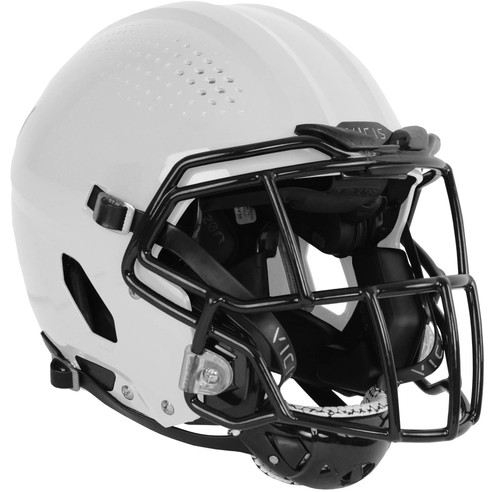
The Riddell Victor-i and VICIS Zero2 Youth Football Helmets are both designed to address the specific needs of youth football players, incorporating scaled-down features from their respective adult models. The Victor-i builds on Riddell’s Victor helmet, using the same shell shape as the Revolution Speed and including inflatable elements for better adjustability. The helmet is equipped with a pre-installed S2B facemask and features a removable comfort liner. The VICIS Zero2 Youth, adapted from the adult Zero2 model, focuses on impact absorption tailored to the lower collision velocities of youth football. It maintains the adult version’s layered structure but modifies key components to reduce weight and better suit younger players.
Protection and Safety
Both helmets offer specialized protection systems designed for youth-level impacts, but they do so in different ways. The Victor-i uses an ABS plastic shell and foam padding throughout the interior. It includes features such as Side Impact Protection, an extended jaw flap, and an interior liner that extends to the mandible area to better manage energy from hits. The Zero2 Youth incorporates a five-layer system built around the RFLX 2.0 structure—an internal layer of columns that buckle under impact. These columns are placed between a deformable outer shell and a reinforced inner shell to absorb and disperse energy. Each helmet prioritizes impact management but with distinct structural and material approaches.
Comfort and Fit
Comfort and fit customization are core aspects of both helmet designs, though they are implemented differently. The Victor-i includes inflatable jaw pads and an inflatable rear liner that allow players to adjust the fit using air. It also features a removable cloth overliner, which adds comfort and is easy to clean. The Zero2 Youth replaces inflatable elements with a modular DLTA Fit System, which uses six pods that snap into different locations inside the helmet. These pods come in various thicknesses and are supported by a Form Liner that locks the head in place. While both systems aim to deliver a secure and personalized fit, one relies on inflatable components and the other on interchangeable pads.
Materials and Weight
The materials used in the two helmets reflect different priorities. The Victor-i has an ABS plastic shell, which helps keep the weight to approximately 2.2 lbs. Its interior features foam padding to reduce impact and maintain comfort. The Zero2 Youth uses a polycarbonate shell, which is typically more rigid than ABS, and includes the RFLX 2.0 column system and DLTA pods. These components are engineered to offer energy absorption without adding excessive weight. Both helmets use lightweight materials suited for younger players, but the types of padding and shell construction differ in composition and function.
Facemask and Visibility
Facemask integration and visibility are handled with different systems in each helmet. The Victor-i includes an S2B facemask designed for skill positions and uses a four-point attachment compatible with Riddell S-Bar facemasks. The facemask is built into the helmet package. The Zero2 Youth comes with one tubular stainless steel facemask and uses a hard-mount system. Its facemasks are designed to optimize both vertical and horizontal sightlines to improve visibility on the field. While both helmets aim to support field awareness and vision, they differ in facemask shape, mounting style, and whether the facemask is standard or optional.
Summary
The Riddell Victor-i and VICIS Zero2 Youth Helmets offer different design approaches to meeting the protective and comfort needs of youth football players. The Victor-i emphasizes adjustability through inflatable components and a lightweight ABS shell, while the Zero2 focuses on structural impact management using column-based protection and a modular fit system. Both helmets include modern facemask compatibility and thoughtful attention to visibility, fit, and on-field performance, with variations in materials, liner systems, and facemask integration reflecting each brand’s design priorities.