
Field Hockey Rules: A Complete Guide for Beginners
Posted by Doug Ervin on Oct 6th 2026
- How a Field Hockey Game Is Played
- Which Field Hockey Rulebook Applies to Your Player
- Fouls, Restarts, and Cards
- Protective Equipment the Rules Require
- Sticks and Uniforms
- Sports Unlimited: Season-Ready Gear, Shipped the Same Day
The Short Answer: Field hockey is played 11 against 11, with each player using a stick to move a ball into the opposing team's goal. The game is built around a few basic rules: players must use the flat side of the stick, keep their stick and body movements safe, and avoid obstructing an opponent from playing the ball.
New field hockey players and their families often learn the game one whistle at a time. The sport can feel confusing at first because teams in the United States may follow different rule sets depending on their league or governing organization. That means two games played during the same fall season can have differences in timing, penalties, and gameplay rules.
How a Field Hockey Game Is Played
The Field and the Clock
A standard field measures 100 yards long and 60 yards wide, with a shooting circle extending 16 yards from each goal. Most competitive games are played on artificial turf, which keeps the ball moving quickly and creates a faster style of play. Under NFHS rules, the game is played in four 15-minute quarters, with two-minute breaks before the second and fourth quarters and a 10-minute halftime. The two long boundaries running along the sides of the field are called sidelines, while the shorter boundaries behind each goal are called end lines. The section of the end line located between the goalposts is known as the goal line.
Players and Positions
Each team fields 11 players: 10 field players and a goalkeeper. Substitutions are unlimited during most stoppages, allowing teams to rotate players throughout the game. There is no offside rule, so players can move freely across the field without needing to stay behind a set line as they would in ice hockey.
How a Goal Counts
Goals have to come from inside the shooting circle, also known as the striking or scoring circle. A shot taken from outside this area only counts if an attacking player touches the ball inside the circle first. That is why a goalkeeper may sometimes allow a long shot to roll into the cage on purpose.
Which Field Hockey Rulebook Applies to Your Player
Three different organizations provide rulebooks for American field hockey, and the differences between them can affect how the game is played. Timing, penalties, and other gameplay rules may vary depending on the league and level of play.
NFHS, NCAA, and FIH
The NFHS Field Hockey Rules Committee creates the rulebook used by high school teams across the United States. NCAA teams compete under International Hockey Federation (FIH) rules with approved modifications, which apply across NCAA Division I and NCAA Division II and III competition. Club, travel, and international players typically follow FIH rules directly.
2026 Rule Changes Worth Knowing
The NFHS and FIH both introduced rule changes in 2026 that affect how some parts of the game are played.
- Mouthguard standards tightened: NFHS Rule 1-6-1 now prohibits attachments on a mouth protector that do not provide a protective purpose or could create a danger to players.
- Penalty corner substitutions narrowed: Under NFHS Rule 4-4-3, substitutions before a penalty corner are only allowed for an ill, injured, suspended, or disqualified defending goalkeeper.
- Halftime standardized: FIH set the halftime interval at 10 minutes beginning March 1, 2026.
- Aerial balls reopened: Opponents may now apply pressure when the receiver touches the ball, instead of waiting for complete control, as long as the five-meter space requirement is respected while the ball is descending.
| NFHS | NCAA | FIH | |
|---|---|---|---|
| Who plays under it | High school teams | All three divisions | Club, travel, international |
| Game length | Four 15-minute quarters | Four quarters of 15 minutes | Four quarters of 15 minutes |
| Halftime | 10 minutes | 10 minutes | 10 minutes |
| Mouthguard | Required | Required for field players | Not mandated |
| Eye protection | Optional | Optional | Optional |
| Team timeout | One 90-second timeout | None | None |
Fouls, Restarts, and Cards
Most stoppages in open play trace back to a short list of infractions.
Common Fouls
- Backsticks: A player strikes the ball with the rounded back of the stick instead of the flat side.
- Feet or body: Contact alone is not automatically a foul. The whistle comes when a player gains an advantage from it or intentionally uses the foot or body to stop, deflect, or propel the ball.
- Obstruction: A player illegally blocks an opponent from playing the ball by using their body or stick. A stationary receiver may face any direction, and the tackler must move around them to make a legal play.
- Third party obstruction: A player runs between an opponent and the ball to prevent them from challenging for possession and give a teammate an advantage.
- Dangerous play: The ball or the stick is raised or swung in a dangerous manner near another athlete. Dangerous play draws the quickest whistle in the sport.
Free Hits and Set Restarts
Fouls can lead to different set restarts depending on where they happen on the field. The two most important scoring opportunities are the penalty corner and the penalty stroke.
- Free hit: Awarded for fouls outside the circle and taken from the spot where the foul occurred, with the opposing team required to stay five yards away.
- Long corner: Awarded when a defender unintentionally plays the ball over the end line. The attacking team restarts play from the 23-meter line (or 25-yard line in high school), aligned with where the ball crossed the boundary. The ball cannot be played directly into the circle. It must first travel at least 5 meters or be touched by another player.
- 16-yard hit: A free hit for the defense when an offensive player puts the ball over the end line. It is taken 16 yards from the goal line.
- Penalty corner: Also called a short corner, this follows a defensive foul inside the striking circle. An attacker inserts the ball from the penalty corner mark on the end line, while defenders, including the goalkeeper, set up behind the goal line.
- Penalty stroke: Awarded for an intentional circle foul or a foul that prevents a likely goal. A penalty stroke gives one attacker a direct attempt against the goalkeeper from the penalty spot.
Green, Yellow, and Red Cards
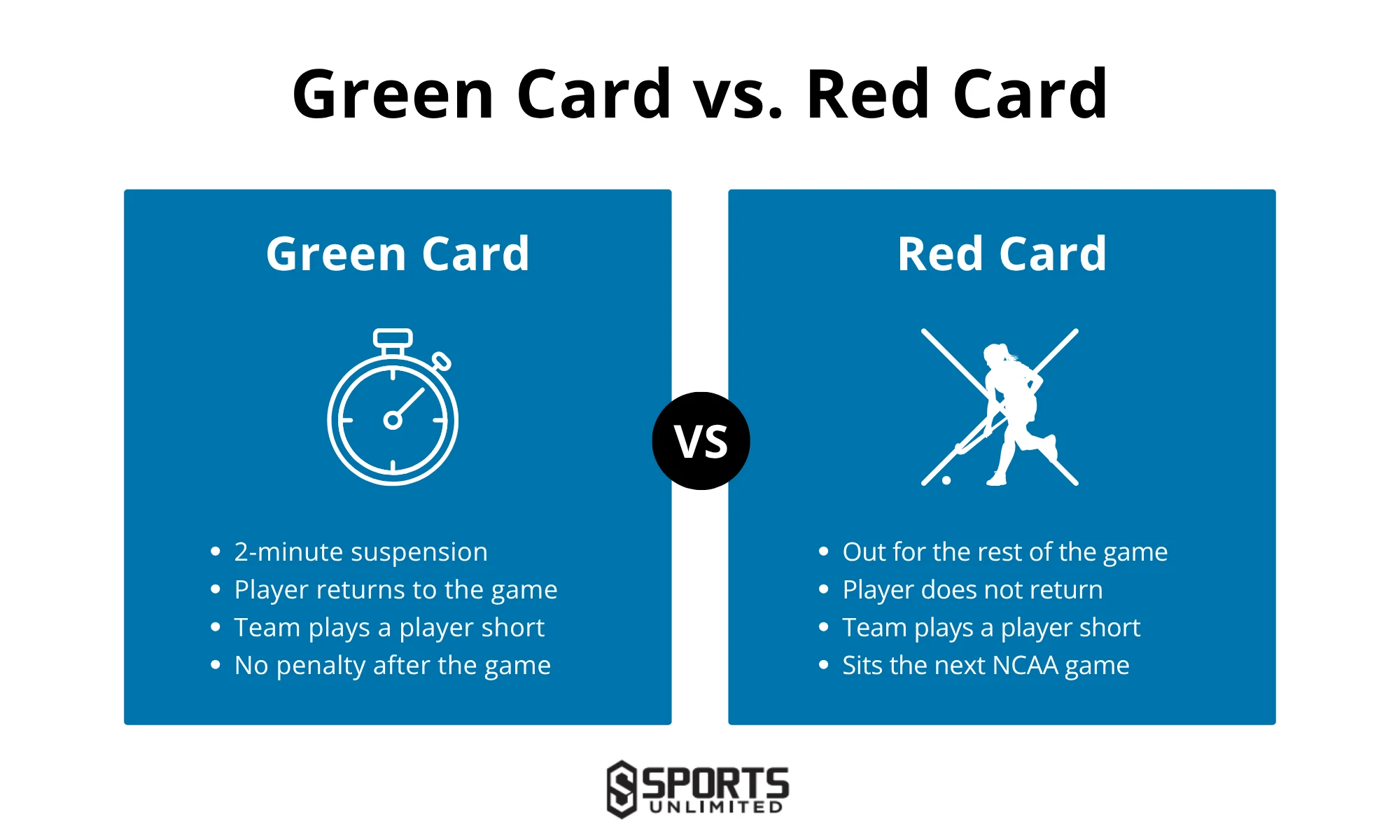
- Green card: A warning that carries a two-minute suspension. The suspension begins when play restarts.
- Yellow card: Temporarily removes a hockey player from the game for a minimum of five minutes, and up to 10 depending on the severity of the foul. The offending team plays a player short until the suspension ends.
- Red card: Permanently removes a player from the game. In NCAA play, a red card also prevents that athlete from participating in the next scheduled contest.
Protective Equipment the Rules Require
Protective gear is not only about comfort. The rulebooks require several pieces of equipment, and umpires check them before hockey players take the field.
Field Players
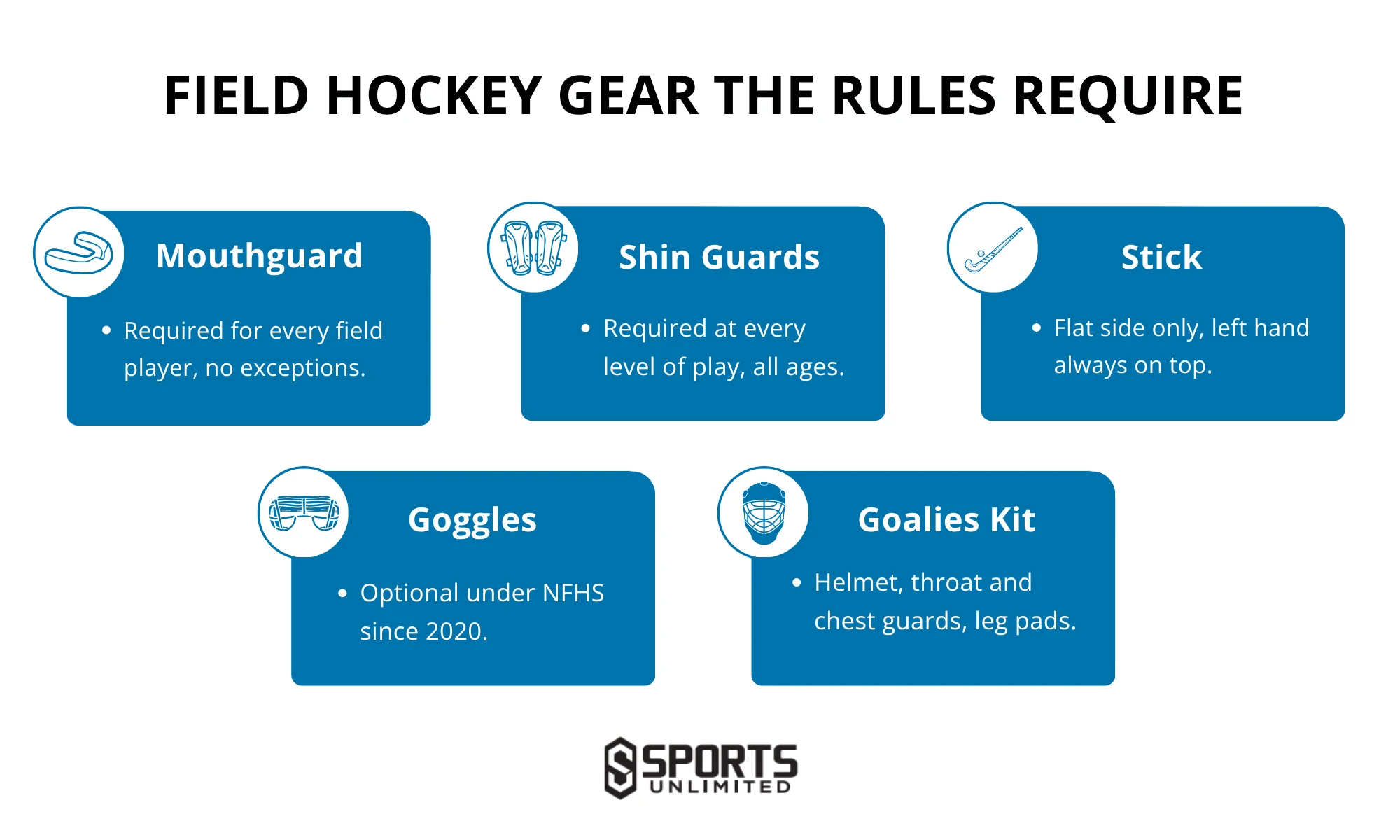
- Mouth protectors are required: NCAA rules consider failure to wear one misconduct, and NFHS has its own mouth protector requirement.
- Shin guards are required: They are standard protective equipment at every level of play.
- Goggles are optional: Under NFHS rules, players may wear goggles, but they are not required. The rule changed in 2020 to allow goggles that meet approved standards.
- Corner masks are required in college: NCAA field players defending a penalty corner must wear a smooth or metal grill face mask. NFHS rules allow a wire-caged version.
Goalkeepers
- A full-coverage helmet is mandatory: Goalkeepers must wear a helmet with fixed full-face protection and coverage at the back of the head.
- Throat and chest protection are mandatory: NCAA rules require both pieces of protective equipment at all times.
- Leg guards and kickers complete the kit: NFHS rules limit goalkeeper pads to 12 inches wide when measured from the front view.
- The jersey must contrast: The goalkeeper wears a numbered top in a color distinct from both teams.
Sticks and Uniforms
A field hockey stick has a flat left side as the only legal playing surface and a rounded back. Because field hockey sticks are designed for one side of play, players must keep their left hand on top, regardless of handedness. Uniform colors are assigned by home team status: the home team wears dark tops, while the visiting side wears white with matching socks. If sock colors clash, the home team must change. At a neutral site, one team is still designated as the home team and handles game management.
Sports Unlimited: Season-Ready Gear, Shipped the Same Day
Knowing the field hockey rules is an important part of being ready for game day. Having the right gear is just as important. Sports Unlimited is a family-owned retailer founded in 1983 and carries equipment for beginners through elite players, including sticks, goalie gear, shin guards, and uniforms from brands like Grays, STX, and CranBarry.
Orders placed before 3 PM ET ship the same day, helping players replace needed equipment quickly when something is forgotten or needs to be replaced. Coaches outfitting a full roster can reach the Team Department at 610-825-5339 for quotes and bulk pricing.